Bull Call Spread vs Bear Put Spread: Key differences, Payoff and When to use
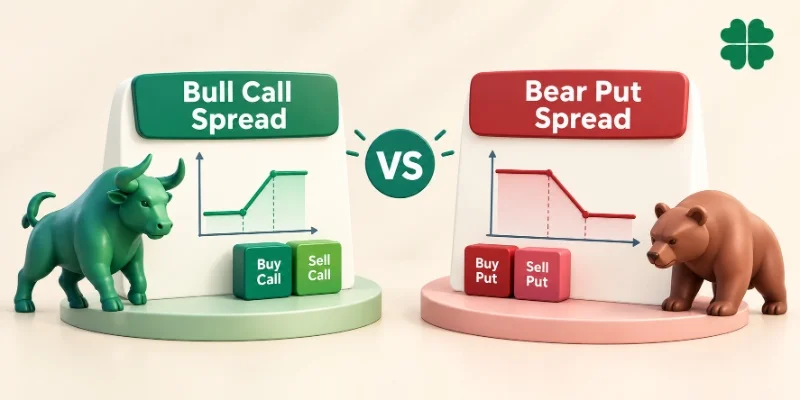
Options trading strategies can be used to take a market view while keeping the potential risk and reward defined. A bull call spread and a bear put spread are two debit strategies with opposite market views. A bull call spread is generally used when a trader expects a limited or moderate rise, while a bear put spread is generally used when a limited or moderate decline is expected. Both strategies have a clearly defined maximum profit and maximum loss. Let’s explore Bull Call Spread vs Bear Put Spread in details below.
What is a Bull Call Spread?
A bull call spread is a bullish options strategy where you buy a Call Option at a certain strike price and sell the same number of Call Options at a higher strike price with the same expiry date. Selling the Call reduces the initial cost but caps the spread’s profit above the higher strike.
The net premium paid is the premium paid for the long Call minus the premium received from the short Call. Maximum profit equals the difference between the strike prices minus the net premium paid and the maximum loss is restricted to the net premium paid.
When to use a Bull Call Spread?
This strategy may be considered when the market outlook and the expected price movement are clearly defined.
A bull call spread may be considered when:
- The market outlook is moderately bullish.
- A rise in the underlying asset is expected before expiry.
- The trader wants a defined maximum loss.
- The cost of buying a Call alone is considered high.
- The trader expects the underlying to rise but does not need unlimited upside potential.
The strategy is less suitable when a trader expects an extremely large rise because the sold higher-strike Call limits the profit beyond that strike.
How does a Bull Call Spread Work?
The bull call spread is utilised when the trader expects the underlying asset to increase in price modestly rather than sharply. Then you buy a call option with a low strike price, and you sell a call option with a higher strike price, but with the same expiry date.
Suppose Nifty is at ₹10,400:
- Buy ₹10,400 Call at ₹150
- Sell ₹10,600 Call at ₹70
Net Premium = ₹150 − ₹70 = ₹80
Maximum Loss = Net Premium = ₹80
Maximum Profit = Strike Difference − Net Premium
= ₹200 − ₹80 = ₹120
Breakeven = Lower Strike + Net Premium
= ₹10,400 + ₹80 = ₹10,480
Breakeven is ₹10,480. Above this level it is a profitable position and maximum profit above ₹10,600.
What is a Bear Put Spread?
A bear put spread involves buying a put option and sell a put option on the same underlying with the same expiration date but different strike prices. The bought put gains value from a fall in the underlying, while the short put reduces the initial premium outlay but also caps the maximum profit.
Net premium paid = Premiums paid – Premiums received. Maximum loss is restricted to net premium paid and maximum profit equals difference between the strike prices minus net premium paid.
When to use the Bear Put Spread Strategy?
Bear put spread can be used when the trader expects a moderate decrease and wants to reduce the potential loss and premium cost:
- The market outlook is moderately bearish.
- A decline in the underlying asset is expected before expiry.
- The trader wants defined downside risk.
- The trader wants to reduce the upfront cost compared with buying a put alone, while accepting capped profit potential.
- Trader does not require unlimited profit potential from a sharp decline below the lower strike.
The strategy is less suitable when the trader expects a very large decline because the sold lower-strike put limits the potential profit.
How does a Bear Put Spread Work?
The bear put spread is utilised when a trader forecasts a moderate decline in the underlying asset. That means you buy a put at a higher strike price and sell a put at a lower strike price but they both expire at the same time. This lowers your upfront payment, but also limits your maximum profit.
Suppose Nifty is trading at ₹10,400:
- Buy ₹10,400 Put at ₹140
- Sell ₹10,200 Put at ₹60
Net Premium Paid = ₹140 − ₹60 = ₹80
Maximum Loss = Net Premium Paid = ₹80
Maximum Profit = Higher Strike − Lower Strike − Net Premium Paid
= ₹10,400 − ₹10,200 − ₹80 = ₹120
Breakeven = Higher Strike − Net Premium Paid
= ₹10,400 − ₹80 = ₹10,320
At expiry, the position is profitable below ₹10,320, with maximum profit at or below ₹10,200.
Bull Call Spread vs Bear Put Spread: Quick Comparison
These two strategies have opposed views of the market and separate option positions to hedge the possible risk and profit. Here is the table showing the main differences between bull call spread vs bear put spread.
| Feature | Bull Call Spread | Bear Put Spread |
| Market view | Moderately Bullish | Moderately Bearish |
| Expected movement | Rise, with limited upside target | Decline, with limited downside target |
| Options used | Calls | Puts |
| Breakeven | Lower strike + net premium | Higher strike − net premium |
| Profit zone | Above breakeven | Below breakeven |
| Number of Positions | 2 | 2 |
| Initial position | Net debit | Net debit |
| Maximum loss | (Strike difference) minus (Net credit) | (Strike difference) minus (Net credit) |
| Maximum profit | Net premium received | Net premium received |
| Time Decay (Θ) | Benefits from time decay (Theta positive) | Benefits from time decay (Theta positive) |
Open your Demat account Today!
Risk and Reward in Bull Call Spread vs Bear Put Spread
Both strategies have defined risk. The maximum loss is known when the trade is entered because the trader pays a net premium.
Risk in a Bull Call Spread
The maximum loss occurs when the underlying expires at or below the lower strike. In this case, both Call Options expire worthless and the trader loses the net premium paid.
The maximum profit occurs when the underlying expires at or above the higher strike. The spread has reached its maximum value, and profit is limited to the difference in strikes minus the net premium paid.
Risk in a Bear Put Spread
The maximum loss occurs if the underlying expires at or above the higher strike. In this case, both Put Options expire worthless and the trader loses the net premium paid.
The highest profit is achieved when the underlying expires at or below the lower strike price. The spread has reached its maximum value and the profit is restricted to the strike difference less the net premium paid.
Advantages and Disadvantages
Bull call spreads and bear put spreads both have defined risk and defined reward, but there are advantages and limitations to each approach that should be considered before starting a trade.
Advantages of a Bull Call Spread
- Maximum loss is limited to the net premium paid.
- The initial premium paid is lower than the premium for buying a Call alone.
- It can benefit from a moderate rise.
- The breakeven level can be calculated before entering the trade.
- The maximum profit is known in advance.
Disadvantages of a Bull Call Spread
- Profit is limited above the higher strike.
- The strategy may not be worth as much if the anticipated appreciation does not take place.
- As the Call approaches expiry, time decay can reduce the value of the spread, although its effect may be less than for a standalone long Call. .
- The underlying must have enough price movement above the breakeven point to generate a profit at expiry.
Advantages of a Bear Put Spread
- Maximum loss is limited to the net premium paid.
- The upfront cost is lower than buying a put alone.
- It can benefit from a moderate decline.
- The breakeven level can be calculated before entering the trade.
- The maximum profit is known in advance.
Disadvantages of a Bear Put Spread
- Profit is limited below the lower strike.
- The strategy can lose value if the expected decline does not occur.
- Time decay can reduce the value of the spread as expiry approaches, although its effect may be less than for a standalone long Put.
- The underlying must fall below the breakeven level to produce a profit at expiry.
Bull Call Spread vs Bear Put Spread: Factors to Check
The following considerations should be evaluated by traders before entering either spread so that they understand the possible costs, risks, returns and applicability of the strategy.
- Strike Prices: The strike difference affects the maximum spread value, while the option premiums determine the net debit and therefore the maximum loss.
- Option Premiums: The net debit is determined by the difference between the premiums. A larger debit increases the amount at risk, but also changes the no-profit, no-loss point.
- Expiry: The expected price move must occur before expiry. As expiry approaches, time decay can affect the spread’s value, although the impact depends on the underlying price, strike prices and implied volatility.
- Volatility: Changes in the implied volatility can affect the option premium and the value of the spread prior to expiration.
- Transaction Costs: The actual return is subject to brokerage, taxes and other relevant charges. Such expenses should be included in the computation of the net result.
Conclusion
The key difference between a bull call spread and a bear put spread is the market direction they are designed to express. A bull call spread is designed for a moderate rise, while a bear put spread is designed for a moderate decline.
Both use two options with the same expiry and provide defined risk and reward. The strike prices, premiums, expiry, volatility and transaction costs should be checked before entering either position.
Bull put spreads and bear call spreads are different strategies that use net credit structures rather than the net debit structures discussed above. Understanding the structure, breakeven, maximum profit and maximum loss is necessary before using any options strategy.
Frequently Asked Questions (FAQs)
What is the main difference between Bull Call Spread vs Bear Put Spread strategies?
The main difference is the market direction. The bull call spread is a bullish stance. The bear put spread is a bearish position. Both are typically utilised when the trader is looking for a move, but not unlimited profit, a moderate move in one direction..
How is the breakeven calculated for bull call and bear put spread?
For a bull call spread, add the net premium paid to the lower strike. For a bear put spread, subtract the net premium paid from the higher strike.