Dividend Yield vs Dividend Growth: How Do They Differ?
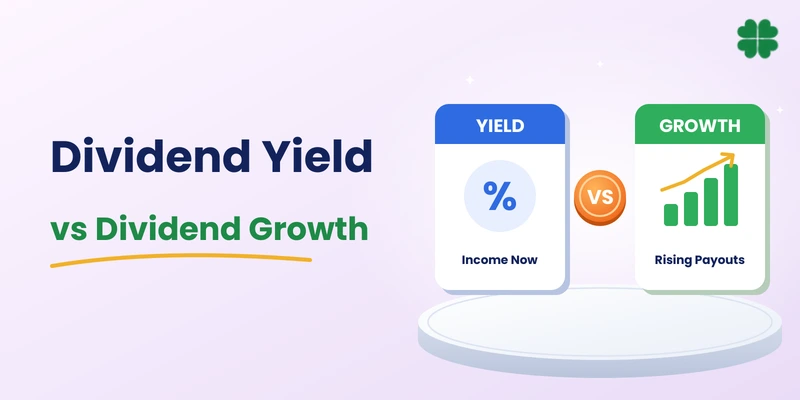
Dividend yield shows how much a company pays out each year compared with its share price, while dividend growth shows how fast that payout is increasing. Both are important for income-seeking investors in shares, but they hint at different strengths. A high yield gives income today. A growing dividend can give a larger income later. Understanding the difference helps in choosing dividend stocks with clear goals.
Dividend Yield
Dividend yield is the annual dividend per share expressed as a percentage of the current market price. It tells an investor the income generated by a share for every ₹100 invested at today’s pricing. If the dividend remains the same, the yield will vary with changes in the stock price.
Dividend Yield Formula and How to Calculate Dividend Yield
The dividend yield formula is simple:
Dividend Yield (%) = Annual Dividend per Share ÷ Current Market Price × 100
To calculate dividend yield, take the total dividends declared for the last twelve months and divide by the share price. If a company pays ₹20 per share in a year and the share trades at ₹800, the yield is ₹20 ÷ ₹800 × 100 = 2.5%.
What is Dividend Growth Investing?
Dividend growth investing focuses on companies that raise their dividend per share regularly, usually supported by rising profits and a steady payout ratio, as discussed in this note on stock dividends and portfolio returns. The starting yield may be small. The attraction is that the payout grows over time, and the yield on the original purchase price, called yield on cost, can rise well above the current yield.
Dividend Yield vs Dividend Growth: Key Differences
The two approaches differ in what they measure and what they reward:
| Basis | Dividend Yield | Dividend Growth |
| What it measures | Income against current share price | Rate of increase in dividend per share |
| Main benefit | Higher income now | Rising income over time |
| Main risk | A falling share price can inflate yield | Growth may slow or stop |
| Suitable for | Investors seeking current income | Investors with a longer investment horizon |
Illustration: Yield Against Growth
Consider two shares bought at ₹400 each. Share A pays ₹16 a year and offers a 4% yield, with no growth. Share B pays ₹6 a year, a 1.5% yield, and raises its dividend by 15% every year. Share A leads in the early years. After five years Share B pays about ₹12.07, a yield on cost of 3.0%. After ten years it pays about ₹24.27, a yield on cost of 6.1%, which is higher than Share A’s 4%. The figures assume constant growth and no dividend cut, and they are not forecasts.
Types of Dividends
Types of dividends affect how income is received and how it should be compared. Below mentioned are the types of dividends.
- Cash dividend: Cash dividend paid directly into the investor’s bank account.
- Stock dividend: Stock dividend is additional shares given to existing shareholders , for example one share for every five owned.
- Interim dividend: Interim dividend is declared by the board of directors during the financial year, which runs from April to March.
- Final dividend: Recommended by the board after the annual accounts and approved by all shareholders.
- Special dividend: A one time payout, often after accumulated profits.
Which Matters More?
The question’s answer mainly depends on the investor’s needs. Retirees or those drawing regular income may prefer a higher yield, provided the payout is sustainable. Younger investors may prefer dividend growth because rising payouts can help offset inflation over time, and the way dividends affect stock returns builds up over the years.
A very high yield can also signal trouble, since a sharp fall in share price raises yield mechanically. The payout ratio, profit growth and debt level should be checked along with yield. SEBI requires the top 1,000 listed companies by market capitalisation to publish a dividend distribution policy, which helps investors understand the company’s approach to dividend distribution.
Tax and Practical Points
Dividends are added to the investor’s income and taxed at the applicable slab rate. Companies deduct TDS at 10% under Section 393(1) of the Income Tax Act, 2025. To receive a declared dividend, shares must be bought before the ex-dividend date, which falls on the record date fixed by NSE and BSE. Investors building a dividend portfolio through equity trading can review the highest dividend yield stocks in India and read the meaning of dividend yield.
Conclusion
Dividend yield measures income today, and dividend growth measures how that income may rise. Neither is better in every case. A balanced approach checks current yield, growth history, payout ratio and business strength together, so that income does not come at the cost of capital.
FAQs
What is the difference between dividend yield and dividend growth?
Dividend yield is the annual dividend divided by the current share price. The dividend growth rate is the rate at which the dividend per share increases over time. Yield measures current income; growth measures how that revenue may change in the future.
How is dividend yield calculated?
The dividend yield is computed by dividing the annual dividend per share by the current market price and multiplying by 100. For example a share that pays ₹20 a year and is valued at ₹800 has a yield of 2.5%. The figure fluctuates as the price moves.
Is a high dividend yield always good?
No. A high dividend yield is not always a sign of a good investment. This could be because the share price has fallen or the company cannot sustain its current dividend. But before you start looking at dividends as a steady income, check at the company’s sales, payout ratio and debt levels.
What is yield on cost?
Yield on cost is the annual dividend divided by initial purchase price per share, multiplied by 100. It increases when a company increases its dividend. That is why dividend growth investing can provide a higher income relative to the initial investment over many years.
Are dividends taxable in India?
Yes. Dividends are taxed in the hands of the investor at the applicable slab rate. Companies deduct TDS at 10% under Section 393(1) of the Income Tax Act, 2025, and exemptions or thresholds in the Act should be checked for the current year.