EV/EBITDA- Meaning, Formula and How to Calculate
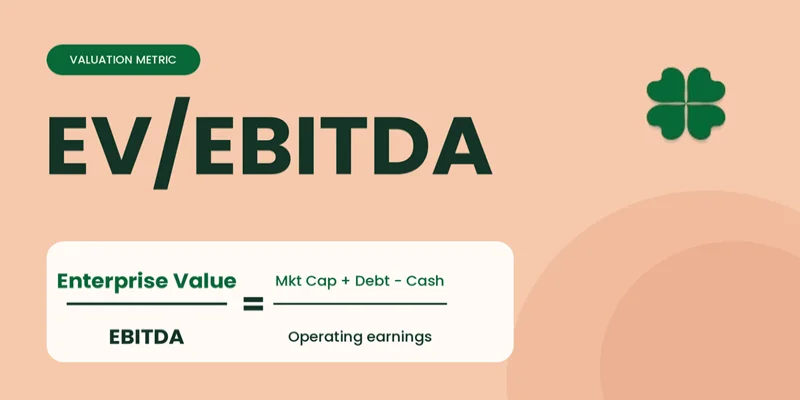
The share price is not a reflection of the true value of a company. Sometimes two companies in the same industry will make similar earnings but be valued differently because of things like debt, cash flow, etc. That’s why investors need metrics like EV/EBITDA that gives a better view of a company’s valuation. It is one of the most common measures used in valuing a firm because it gives a broader overview of the value and performance of the firm.
Equity research, investment banking, private equity and mergers and acquisitions frequently use the EV/EBITDA ratio, which offers a comprehensive valuation of the firm. This is because it considers enterprise value and EBITDA, allowing investors to assess how much the market is valuing a business relative to its operating earnings.
Knowing how to calculate EV/EBITDA is critical for stock analysis. Learn about the EV/EBITDA ratio, how to calculate it, and why it is an important financial ratio for analysing a company’s valuation.
Key Takeaways
- Gives valuation of the business entity in terms of its operating income.
- Compares Enterprise Value (EV) with EBITDA.
- It considers the whole business entity and thus gives a better picture than market capitalisation.
- Is not influenced by the financing decisions, tax structures and accounting expenses.
- Used for comparing companies within the same industry.
- Determines if the business entity has undervalued or overvalued earnings potential.
Enterprise Value (EV)
Enterprise value is a measure of the total value of a business all capital providers. While market capitalisation only considers the value of equity, enterprise value takes into account debt and other claims on the business, while subtracting cash and cash equivalents.
The Enterprise Value (EV) formula is:
Enterprise Value = Market Capitalisation + Total Debt + Minority Interest + Preferred Shares − Cash and Cash Equivalents
Enterprise value answers a simple question:
What would it cost to buy the whole company?
This is why the EV is often called the theoretical business takeover value.
EBITDA
EBITDA means Earnings before interest, tax, depreciation and amortisation. It reflects a company’s operating earnings before accounting for the impact of:
- Funding decisions
- Tax regimes
- Depreciation expenses
- Amortisation of costs
The formula can be written as: EBITDA = Operating Profit + Depreciation + Amortisation
Since EBITDA is based on the business’s operations, it allows for a standardised comparison of companies regardless of differences in their financing, tax or accounting practices.
How to Calculate EV/EBITDA Ratio?
The EV/EBITDA ratio measures a company’s enterprise value relative to its earnings before interest, taxes, depreciation and amortisation. The EV/EBITDA ratio is the amount investors are willing to pay for each unit of a company’s operating earnings.
EV to EBITDA formula = Enterprise Value / EBITDA
For example:
| Metric | Value |
| Market Capitalization | ₹12,000 crore |
| Total Debt | ₹3,000 crore |
| Cash and Cash Equivalents | ₹1,000 crore |
| Enterprise Value (EV) | ₹14,000 crore |
| EBITDA | ₹2,000 crore |
| EV/EBITDA Multiple | 7x |
A) Factors in debt and cash
A company might appear inexpensive based on its market capitalisation, but a high level of debt can make a big difference to its overall valuation.
Enterprise value includes debt and cash, which gives a more complete picture of a firm’s valuation
B) Mitigates Capital Structure Distortions
Two identical firms can have very different financing structures. One may be highly debt-funded, the other mostly equity funded. The EV/EBITDA ratio helps to remove these differences to make comparisons more meaningful.
C) Widely Used Across Many Industries
EV/EBITDA is widely used across the following industries:
- Pharmaceuticals
- Information Technology
- Telecom
- Consumer Products
- Infrastructure
It is particularly helpful when you are comparing companies in the same industry.
Why EV/EBITDA Matters When Valuing a Company?
The following points highlight the importance of EV/EBITDA:
1. Total Business Value Metrics
The P/E ratio looks only at equity holders, while EV/EBITDA looks at the value of the entire business, including debt obligations.
2. Widely Used for Mergers and Acquisitions
When a company gets acquired, the purchaser is looking at the value of the whole business and not simply the shares in it.
Therefore, the EV/EBITDA multiple is a very common multiple used in mergers, acquisitions and corporate deals because it measures the total value of the business and not its equity value. Enterprise Value (EV) is the market value, debt and cash of a business. So, it provides a broader understanding of what the acquirer would pay to take over the business. This ratio becomes very convenient to use when the businesses differ from each other in terms of their capital structure and debts.
3. Assists in Relative Valuation
Many analysts use a company’s EV/EBITDA ratio to compare it with its industry peers.
For example:
| Company | EV/EBITDA |
| Company A | 8x |
| Company B | 12x |
| Company C | 15x |
This means that Company A’s multiple is lower than the multiples of the companies in the same industry, which implies that there is a chance of a valuation gap between the two groups.
4. Focuses on Operational Performance
Items which can vary greatly between firms are not included in EBITDA. This allows investors to focus on efficiency rather than accounting or financial variations.
Types of EV/EBITDA
The ratio is influenced by industry dynamics, growth prospects, profitability, and business quality.
Lower EV/EBITDA
A lower ratio could mean:
- Potential undervaluation relative to peers
- Slower growth prospects
- Increasing business risk
- Challenges specific to the industry
But a lower ratio shouldn’t automatically be seen as a good EV/EBITDA ratio for buying opportunity.
Higher EV/EBITDA
A higher ratio may signal the following:
- Strong growth prospects ahead
- Premium market positioning
- Increased profitability
- Positive Investor Sentiment
Generally, a fast growing technology company is likely to have a higher EV/EBITDA valuation multiple than mature companies.
EV/EBITDA vs PE Ratio (Price-to-Earnings Ratio)
EV/EBITDA and P/E Ratio (Price-to-Earnings) both are widely used valuation metrics, but each serves a different purpose. See the below comparison table for more detail:
| Feature | EV/EBITDA | P/E Ratio |
| Debt Included | Yes | No |
| Adjusts for Cash | Yes | N/A |
| Based on Operating Earnings | Yes | No |
| Used in Acquisitions | Yes | Limited |
| Affected by Capital Structure | Less | More |
For highly leveraged businesses, EV/EBITDA usually gives a better valuation picture than the P/E ratio.
How does the Significance of EV/EBITDA Influence Valuation?
- Facilitates Fair Comparisons: As the ratio only considers operating efficiency, the analysts get to compare companies within the same industry despite their different capital structures.
- Helps in Mergers & Acquisitions: EV/EBITDA is a common ratio used in analysing companies prior to takeover and merger deals, as enterprise value measures the value of the business to its capital providers.
- Mitigates the Effect of Different Accounting Policies: The impact of various accounting policies is reduced, as EBITDA does not incorporate depreciation and amortisation.
- Popular Among Financial Analysts EV/EBITDA is often used by investment bankers, institutional investors, private equity firms and financial analysts to assess valuations of companies.
EV/EBITDA Limitations
The ratio is not perfect, but it has many limitations.
- Disregards capital expenditure: Many industries require heavy reinvestment into assets. EBITDA makes no allowance for any future capital expenditure requirements.
- Excludes changes in working capital: The metric does not incorporate changes in inventory, receivables or payables.
- Not for Money Management Companies: EV/EBITDA is less useful for banks and financial institutions, as they have their own capital structures.
Example of EV/EBITDA Analysis
Assume that there are two firms in the cement industry.
| Metric | Company A | Company B |
| Enterprise Value (EV) | ₹50,000 crore | ₹60,000 crore |
| EBITDA | ₹5,000 crore | ₹5,000 crore |
| EV/EBITDA | 10x | 12x |
Company A trades at a lower EV/EBITDA multiple than Company B. This may indicate a lower relative valuation, but investors should examine whether the difference is justified by differences in business fundamentals.
However, investors should also consider the following factors before making an investment decision:
Prospects for growth
- Debt ratios
- Margins
- Market share
- Industry forecast
This example shows why EV/EBITDA is a starting point and not an ending point.
Open your Demat account Today!
Conclusion
EV/EBITDA is one of the most common valuation multiples used to value the whole firm. One advantage of EV to EBITDA is that it considers enterprise value rather than only equity value. Understanding EV/EBITDA – Enterprise Value / EBITDA (Earnings Before Interest, Tax, Depreciation and Amortisation), how it is calculated and its importance will help investors in making investment decisions.
Although this ratio gives a different view on the valuation and operations, it should never be used in isolation and should always be used with other financial ratios. The EV to EBITDA ratio is a great way to evaluate companies and find undervalued businesses when done properly.
Related Links
| What is PE Ratio | What is Return on Assets | Position Sizing |
| What is P/B Ratio | Valuation of Shares | Option Strategy Builder |
Frequently Asked Questions (FAQs)
What should be the correct price-to-EBITDA ratio?
The ratio varies from industry to industry. A low ratio in relation to the same industry competitors means that the firm may be undervalued, whereas a higher ratio indicates growth opportunities or a high-quality firm.
Why is the EV/EBITDA ratio more useful than the P/E ratio?
The EV/EBITDA ratio takes into account the net debt and cash of the company. This is useful in comparing firms with different capital structures.
Can EV/EBITDA be negative, and what does it mean?
Yes, it is possible to have negative EV/EBITDA where the firm is having negative EBITDA due to non-profitable core business activities. The negative ratio has no benefit for the valuation of the firm. Analysts use other financial ratios in these cases.
What industries use the EV/EBITDA ratio?
The EV/EBITDA ratio is used in various industries such as manufacturing, technology, healthcare, telecom, consumer goods, energy and infrastructure. However, the usage of the EV/EBITDA ratio for financial service providers such as banks and insurance companies is not as widespread, as they have an entirely different model.