

Invest Early. Capture NewOpportunities with NFOs
Explore newly launched mutual fund schemes designed to unlock emerging themes, sectors, and strategies.
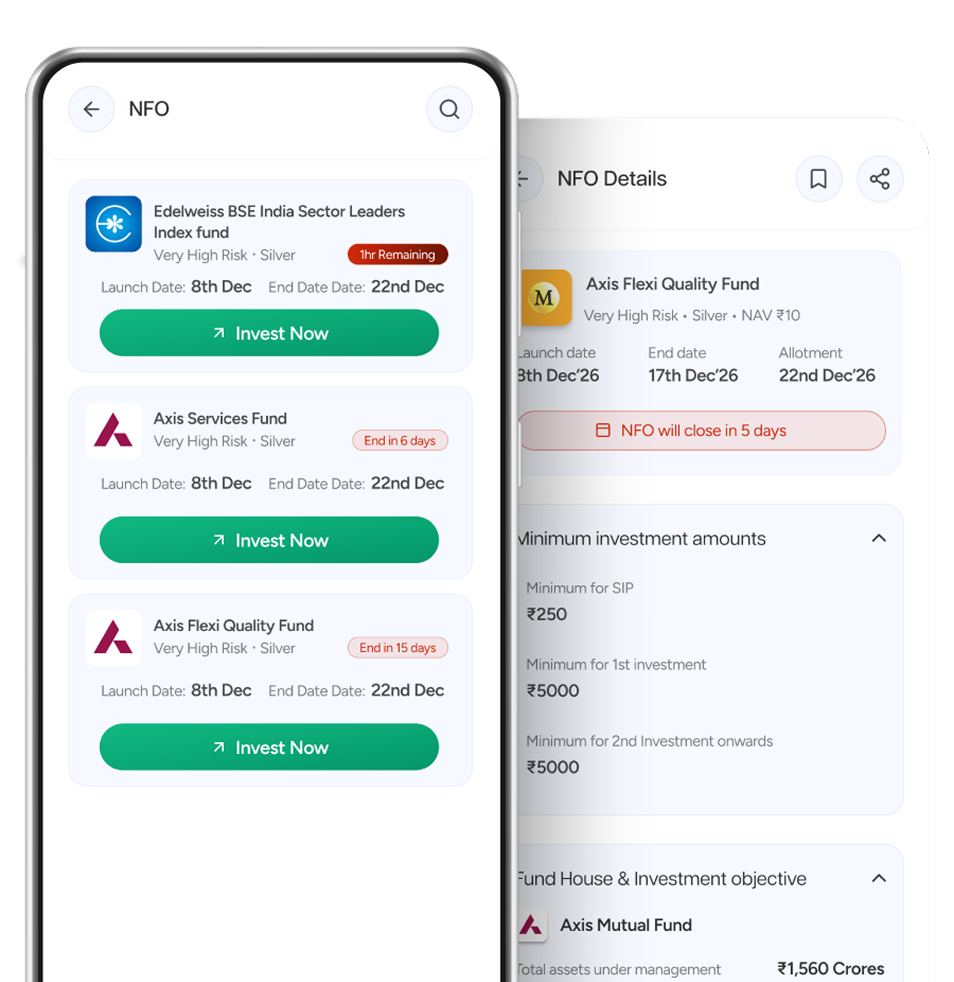
Why Invest in NFOs?
NFOs provide unique opportunities to access new investment themes and strategies.

Early Entry
Invest in an NFO at a base NAV of ₹10 and join the fund’s growth journey right from day one

Fresh Portfolio
The fund manager builds a portfolio specifically optimized for present market conditions.

Exclusive Themes
Access innovative sectors (like AI, Green Energy) that traditional funds may not have invested.

Strategic Diversification
Diversify your investments with emerging sectors and unique asset builds to your portfolio.
Who Should Consider NFO?
Perfect for investors seeking new opportunities and portfolio diversification
Thematic Investors
SIP Investors
Long-Term Investors
Portfolio Diversifiers
New Fund Offerings (NFO)
Discover investment options designed for every financial journey
How to Invest in NFO
Start investing in NFOs in simple steps

Login to App
Open your Religare Dynami App or web portal and log in with your secure credentials.

Select NFOs
Navigate to the Mutual Funds section from the main menu and click on Transact.

Pick NFO
Browse the list of live offers, select preferred scheme, and choose Lump sum or SIP

Make Payment
Enter investment amount, complete the payment via UPI or Net Banking.

Why Choose Religare Broking
We combine three decades of trust with advanced technology for seamless execution. Our clients trade with absolute confidence, backed by professional research and market insights.

30+ Years
of Trust

All-in-One,
Web and Mobile Platform

1300+
Touch Points

Client Centric
Approach
Understanding NFO
Here is a comprehensive guide on NFOs so that you can make an informed and confident investment decision.
What is NFO in Mutual Funds?
Each mutual fund scheme begins as a New Fund Offer (NFO), a time during which an asset management company opens a new scheme for subscription. During an NFO, investors can subscribe to a new mutual fund scheme at its specified offer price, often ₹10 per unit. This price is not a discount and does not make the scheme cheaper than an existing fund. Understanding NFO meaning helps investors assess a scheme’s suitability and decide whether to invest or wait for a track record.How It Differs from a Regular Mutual Fund
An NFO mutual fund is a newly launched fund that is open for initial subscription before it can begin its performance track record. The AMC announces the scheme’s investment objective, asset allocation, investment strategy and fund manager details before opening a fixed subscription period during which investors can purchase units. It is common to offer units at ₹10 each during this period. After the NFO closes and units are allotted, open-ended schemes allow ongoing purchases and redemptions at the applicable NAV. Close-ended schemes are listed on stock exchanges, where their trading prices may differ from their NAV.How NFO Works, Step by Step
An NFO is carried out in a number of steps, starting with the scheme launch and ending with allocation of units to investors.- The AMC prepares and submits the offer document of the scheme, which explains the scheme’s investment objective, subscription dates, investment strategy, risks and fund manager details..
- The NFO is launched, and investors can apply via a broker or directly with the AMC.
- The announced date is the day the window closes and units are normally allotted in less than 5 working days.
- After allotment, open-ended schemes become available for ongoing transactions at the applicable NAV. Close-ended schemes are listed on stock exchanges for trading.
- Under the SEBI amendment effective from 1 April 2025, AMCs should invest NFO proceeds within 30 business days of allotment. In exceptional cases, the AMC’s Investment Committee may extend the deployment period by an additional 30 business days, subject to the prescribed conditions.
Types of New Fund Offers in Mutual Funds
NFO mutual funds are offered under three structures, each determining when investors can buy or redeem units.- Open ended: Open ended funds remain open to purchases and redemptions after the NFO. After the first offer closes, investors have the option to continue to purchase or sell units on any business day at the current NAV, and there is no specified date the scheme ends.
- Close ended: A close ended scheme receives money during NFO. After that window closes, no additional subscriptions can be made and the fund has a set term. Investors who wish to redeem the fund before maturity must sell their units on the stock exchange where the fund is listed, in accordance with SEBI's listing requirements.
- Interval funds: Interval funds are a combination of open-ended and close ended funds, in which transactions can occur within defined periods. The AMC has certain transaction windows at regular intervals and during these periods buying and redemptions can be made.
- NFO Period: What Is NFO Period in Mutual Fund Terms
NFO in Mutual Fund vs NFO in the Stock Market
People searching for what is NFO in stock market may get confused between a mutual fund NFO and an IPO, as both involve offering investments to the public for the first time. An NFO applies specifically to mutual fund schemes raising money to build a portfolio managed by an AMC. An IPO involves a company offering its own shares to the public for the first time. Unlike an IPO, an NFO does not involve listing shares on a stock exchange, although both involve an initial public subscription.Benefits of Investing in NFO
The benefits of investing in NFO mainly relate to initial access and subscription terms, rather than any assured advantage over existing funds.- Investors can access a scheme’s investment theme or strategy at launch, including niche or sector-focused options, before the fund establishes a performance track record.
- NFO units are often offered at ₹10 per unit. A lower initial NAV does not imply better value or higher future returns. Lower unit price does not mean higher returns.
- The ability of a fund manager to invest the money collected not at once but over a period when market conditions determine the situation.
- The scheme is managed by a SEBI-registered mutual fund and AMC and operates within the applicable regulatory framework.
NFO Advantages and Disadvantages
Assessing the benefits alongside the risks helps investors make a more informed decision before investing. Key Factors to Check Before Investing in an NFO Evaluate each NFO against a consistent checklist rather than choosing one based on its advertising.- Determine the Investment objective. Does the strategy fill a gap in your existing portfolio, or can you find a similar fund with a track record to evaluate
- Check the fund manager's background, their experience and performance history across other schemes.
- Check the risk-o-meter rating and category of the scheme, like equity, debt, hybrid or sectoral, and look at how it fits your financial objectives and risk-taking levels.
- Compare the cost ratio and the exit load after the AMC reports them.
- See whether the scheme is open-ended or close-ended and know how easily you can access your money.
Is an NFO Good for Investment?
An NFO may be worth considering if its investment objective matches your financial goals and the scheme fits your risk appetite. However, a ₹10 initial unit price does not make it cheaper than an existing mutual fund. Since an NFO has no performance history of its own, check its investment strategy, fund manager’s experience, planned portfolio, costs and risks before deciding whether it suits your needs. Before making an investment decision, learn more about mutual fund investment opportunities at Religare Broking and compare schemes by their investment goals, risk and cost.Trade Anytime,
Anywhere
Experience seamless trading app with advanced features, intuitive design, and lightning-fast execution.

Unified Portfolio
All Assets, One App
Instant Market Alerts
Live Research, Zero Delay
Seamless Security
Biometric Login for Safe Trading
Actionable Ideas
Pre-built Options Strategies
Based on 27.8K reviews
1M+
Downloads