What are the differences between Stop Loss and Trailing Stop Loss?
Every trader eventually has to decide how to exit a position that moves against them, and the two most common tools for that are a stop loss and a trailing stop loss. Both help manage risk, but a stop loss stays at a fixed price to limit losses, while a trailing stop loss moves with favourable price changes to protect profits. Knowing the differences between Stop Loss and Trailing Stop Loss before executing a trade helps you avoid closing winning trades too early or holding losing trades for too long.
What is a Stop Loss?
A stop loss is an order placed with a broker that will activate when the market hits a defined trigger price, at which point it will convert to a market or limit order. It is designed to help limit potential losses to a certain amount. It will remain at that price unless the trader manually adjusts it. Its orders can be placed as market or limit orders, subject to the broker and exchange supporting the corresponding order type.
Once triggered, a stop loss market order becomes a market order and is generally more likely to be executed, but the execution price is not guaranteed and may differ from the trigger price. A stop-loss limit order becomes a limit order after the trigger is reached, providing greater control over the execution price but carrying a risk of non-execution during sharp price movements. Availability varies by exchange and market segment.
Read also: How to calculate Stop Loss?
What is a Trailing Stop Loss?
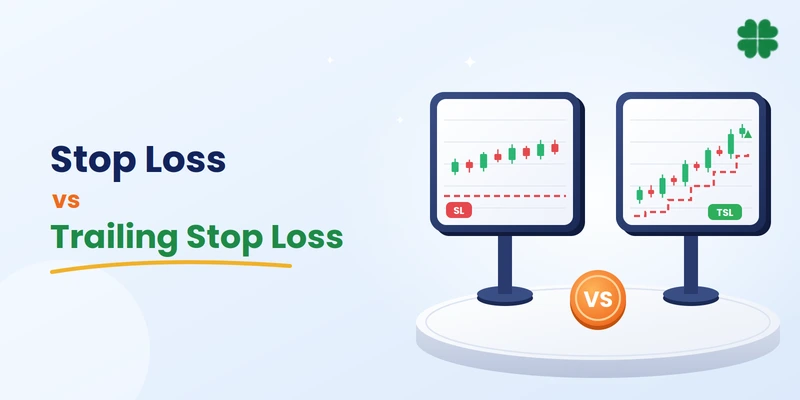
A trailing stop loss starts the same way, as a trigger price set below the entry for a long position, but it does not stay fixed. As the stock price rises, the trigger price moves up, keeping a fixed distance from the market price, measured in rupees, as a percentage, or using the Average True Range (ATR).
If the price then reverses, the trigger stays at its most recent level rather than moving back down, and the order fires once the price falls to that point. A trader who buys a stock at ₹600 with a trailing distance of ₹10 starts with a stop at ₹590. If the price rises to ₹630, the stop moves to ₹620. A fall to this level triggers the exit, securing a gain instead of letting the price fall back to the fixed stop at ₹590.
Stop Loss vs Trailing Stop Loss: Key Differences
The key difference lies in how the trigger price changes as the market moves. The table below explores the differences between stop loss and trailing stop loss.
| Aspect | Stop Loss | Trailing Stop Loss |
| Trigger price | Stays fixed until changed manually | Moves up automatically as price rises |
| Main purpose | Caps the loss from the entry point | Protects profit as the trade moves favourably |
| Behaviour on reversal | Remains unchanged | Holds at its most recent level, doesn’t move back down |
| Monitoring needed | Set once, revisited only if the trader wants to adjust it | Can update automatically through supported broker-platform features; manual trailing is also possible. Automatic trailing is not a standard exchange-native order type. |
| Best suited for | Trades where the maximum acceptable loss is known upfront | Trending trades where letting a winner run matters more than locking in an early exit |
When to use Each?
Stop loss is ideal for traders who wish to define an exit price based on their risk tolerance. This tends to work effectively for short defined trades such as intraday positions where the trader already knows the utmost they can risk before entering.
A trailing stop-loss works well for deals planned to last multiple sessions. It allows for typical market volatility while modifying the exit point to protect earned gains. Swing and position trades, where a stock is expected to move steadily over several sessions, are a more natural fit for this approach than a single volatile day.
Limitations and Considerations when using Stop-Loss Orders
Both order types carry the same limitation around overnight risk.
If the price gaps down well below the trigger level before the market opens, a stop market order may be executed at the next available market price rather than at the trigger price., A stop limit order, however, may remain unexecuted if the market price moves beyond the specified limit. Therefore, both stop loss and trailing stop loss orders leave the exact exit price uncertain in such situations.
For futures and options, tracking the underlying index can be more effective than tracking the option premium, as premiums can fluctuate sharply even when the index remains relatively stable.
On Indian trading platforms, a basic stop-loss order can generally be placed through the order form, subject to the available order types. Automatic trailing stop losses depend on the broker’s supported features and may be available through facilities such as Good Till Triggered (GTT) orders. Check the broker’s rules for the relevant exchange, market segment and order type before placing an order.
Open your Demat account Today!
Conclusion
A stop loss and a trailing stop loss both exist to manage downside, but they answer different questions. A stop loss asks how much loss is acceptable from the entry price, while a trailing stop loss asks how much of an unrealised gain is worth protecting as a trade develops. Choosing one or using both at different stages depends on whether the goal is to limit losses or protect profits already earned.
FAQs on Stop Loss vs Trailing Stop Loss
What is the main difference between a stop loss and a trailing stop loss?
A stop loss is set and it stays there. A trailing stop loss automatically rises up with the price to secure more of your gain.
Does a trailing stop loss protect against overnight gaps?
No. If the price opens much below the trigger level overnight, the order will fulfill at the next available price which can be a lot worse than the trigger you set.
Which is better for a beginner, stop loss or trailing stop loss?
A plain stop loss is usually easier to understand and control, because the trigger price does not alter. This kind of stop loss is good for a trader who does not mind following a moving exit point.
Can a trailing stop loss move downward if the price falls?
For a long position, the trigger only moves in the favourable direction. Once the price reverses, the trigger holds at its last level rather than following the price down further.
Is a trailing stop loss available on all Indian trading platforms?
Not always as native exchange order type. Some brokers offer it as a feature of the platform but others need manual adjustment or automated trading tools to get the impact.