Market depth is a live view of pending buy and sell orders at different price levels for a share. It shows how many shares are waiting to be bought or sold at each price. Checking market depth before placing a trade helps traders estimate potential execution prices, assess liquidity and understand the visible buying and selling interest at different price levels. VWAP, by comparison, provides a volume-weighted average price benchmark for the trading session.
What is Market Depth in Stock Market?
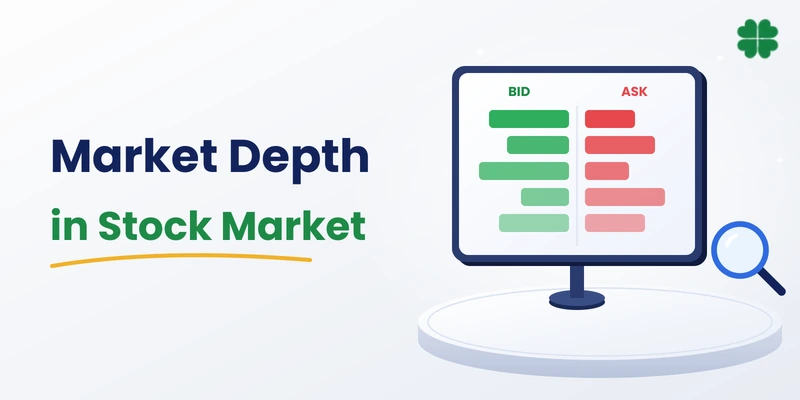
Market depth is a window on the order book that lists orders which have been placed but not yet traded. Market depth in stock market platforms is usually shown as five rows of buyers and five rows of sellers, each with a price and a quantity. The data changes every second as orders are added, changed, cancelled or matched. Depth is a snapshot of pending trading interest and not a record of completed trades.
Order Book in Stock Market and Buy and Sell Orders
An order book on a stock exchange like NSE, BSE gives the list of all the pending buy and sell orders for an asset. The matching of buy and sell orders is done first by price, and then by time. The buy side, called the bid side, lists buyers with the highest price at the top.
The sell side is termed the ask or offer side and shows the sellers with the lowest price at the top. Market orders are executed and only limit orders remain in the book. It is essential to understand the difference between order book and trade book, as this will help you to clarify the specific function of each record in stock trading.
What is Bid Price and Ask Price?
The ask price is the lowest price a seller is ready to accept and the bid price is the greatest amount a buyer is currently willing to pay. The difference is the spread. If the best bid is ₹99.90 for 500 shares and the best ask is ₹100.10 for 600 shares, the spread is ₹0.20. Bid and ask price quotes and the bid ask spread are the first items to read in any depth window.
The Five Level Order Book
A five level order book shows the best five bids and the best five asks. The example uses assumed prices and quantities:
| Bid Quantity |
Bid Price |
Ask Price |
Ask Quantity |
| 800 |
₹100.00 |
₹100.10 |
600 |
| 500 |
₹99.95 |
₹100.15 |
400 |
| 700 |
₹99.90 |
₹100.20 |
500 |
| 600 |
₹99.85 |
₹100.30 |
700 |
| 400 |
₹99.80 |
₹100.35 |
900 |
| 3,000 |
Total |
Total |
3,100 |
The spread is ₹0.10, and the two sides are nearly balanced. A market order to buy 1,500 shares would take 600 shares at ₹100.10, 400 at ₹100.15 and 500 at ₹100.20. The average price is ₹100.147, which is about ₹70 more than the best ask on the full order. A limit order at ₹100.10 avoids that extra cost but may not be filled completely.
How to Read Market Depth Before Placing a Trade?
A few checks make the depth window useful:
- Look at the spread first.
- Compare the quantity at the best price with the size of the planned order.
- Check the total buy and sell quantity, since a strong imbalance may show pressure on one side.
- Look for large clusters of orders, which may act as potential support on the bid side or resistance on the ask side.
- Confirm with price action and volume, because the book can change within seconds.
Knowing what trading volume is helps explain whether trading activity supports the buying and selling interest shown in the market depth.
Market Liquidity and Depth
Market liquidity describes how easily a share can be bought or sold without moving its price. A deep book has many orders across many prices, so a large order can be absorbed with little impact. A shallow book has few orders, so the same order may push the price across several levels. Thinly traded stocks and far strike options often show wide spreads, and crossing the spread is a real cost.
Level 2 Market Data and Deeper Views
Market data is described in levels. Level 1 shows the best bid and best ask with the last traded price. Level 2 market data shows the order book beyond the best price, which on NSE is five levels on each side. Level 3 data extends this to up to twenty levels, as in the 20 market depth window offered by some brokers. Availability and cost differ by broker.
Market Depth Indicator
The market depth indicator is usually the depth window itself, often with a bar or colour that compares total buy and sell quantities. It is not a separate signal that predicts direction. Traders read it along with price action, volume and intraday indicators.
Limitations of Market Depth
Depth shows only limit orders, and these can be changed or cancelled at any time. Large orders that appear and disappear before the price reaches them may be placed to mislead other market participants, a practice called spoofing. Part of an order can also stay hidden through the disclosed quantity feature. Depth cannot guarantee a fill price or predict the next move, and it should support a plan with an entry, a stop loss and a position size. Depth for each stock can be viewed on the trading platform when placing orders through equity trading.
Conclusion
Market depth gives a live view of visible pending buy and sell orders at each price. The spread, the quantity at each level and the balance between the two sides help in estimating the potential execution price, available liquidity and possible trading costs.
FAQs
What is market depth in the stock market?
Market depth is a live display of pending buy and sell orders at different prices for a security. It usually shows the best five bids and five asks, with the quantity at each price, and helps traders judge liquidity and likely fill prices.
What is the difference between bid price and ask price?
The bid price is the highest amount a buyer is willing to pay. The ask price is the lowest price a seller is willing to accept. The difference between them is the spread which is an immediate trading cost for a buyer or seller who executes against the opposite side of the book. A trade happens when compatible buy and sell orders are matched.
What does a five level order book show?
It shows the five best buy orders and five best sell orders, each with price and quantity. Traders use it to compare the two sides, judge the spread, see the quantity waiting at each price and place limit orders at sensible prices.
How does market depth show market liquidity?
A liquid stock has many orders close to the best bid and ask, a narrow spread and large quantities. A stock with thin depth and a wide spread is less liquid, and even a modest order can move its price.
Is market depth enough to decide a trade?
No. Orders in the book can be changed or cancelled quickly, and some order quantities may not be fully visible. Depth should be combined with price action, volume, news and a stop loss before any trade is placed, since no single tool is reliable alone.