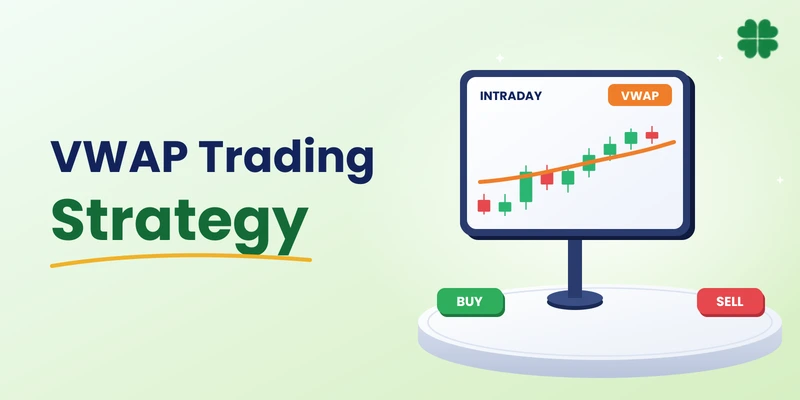
VWAP stands for Volume Weighted Average Price, the average price at which a share has traded in a session, with each price counted according to the volume traded at it. Retail traders read it as an indicator on the chart, while institutional traders use it as a benchmark and as an execution method for large orders. The two uses explain what VWAP is in trading and why it is widely followed.
What is VWAP?
The VWAP full form is Volume Weighted Average Price. In the stock market, a price with higher trading volume carries more weight than one with fewer shares traded. VWAP in stock market analysis is calculated from the start of the session and resets at the next open, which is why it is mainly an intraday tool. VWAP in share market data is available for NSE and BSE stocks.
VWAP Formula and a Worked Example
The formula is:
VWAP = Σ (Price × Volume) ÷ Σ (Volume).
Consider three trades: 100 shares at ₹100, 200 shares at ₹102 and 150 shares at ₹98. The total value is ₹10,000 + ₹20,400 + ₹14,700 = ₹45,100, and the total volume is 450 shares. The VWAP is ₹45,100 ÷ 450 = ₹100.22. A simple average of the three prices would be ₹100, so the heavier trade at ₹102 pulls VWAP slightly higher. Charting platforms use the typical price of each candle, the average of its high, low and close.
VWAP Indicator on the Chart
The VWAP indicator appears as a single line drawn over the candles and rebuilt every day. Price above the line indicates that the stock is trading above its session volume-weighted average price, while price below the line indicates that it is trading below that average. The line can also act as support or resistance. The types of stock market indicators show where VWAP fits among trend and volume tools.
How to Use VWAP Indicator
Using the VWAP indicator involves a few simple steps:
- Open an intraday chart and add VWAP, so that the line starts from the market open.
- Note whether price is above or below the line, and whether it has stayed on one side since the morning.
- Wait for price to move away and return to the line, rather than entering during a strong price movement.
- Confirm with volume or a second indicator such as a moving average, and place a stop loss just across the line.
- Exit when price closes decisively on the other side of VWAP.
Traders can use VWAP with other tools and refer to the top indicators for intraday trading to explore other ways of analysing price movements.
VWAP Intraday Strategy
A VWAP intraday strategy usually follows one of two setups. In a pullback setup, a stock above VWAP falls back to the line and holds, and the trader buys with a stop under the recent swing low. In a breakout and retest setup, price crosses VWAP with rising volume, returns to test the line from the other side, and then continues.
A stock that keeps crossing VWAP in both directions is range bound, and the signal is weak. VWAP tends to work better with highly traded stocks. Factors covered in how to decide a stock for intraday can help traders select suitable stocks.
VWAP Trading Strategy for Institutions
The VWAP trading strategy used by institutions has a different aim. A fund buying several lakh shares cannot place the whole order at once, because the buying itself would raise the price. The order is divided into small slices sent in proportion to the stock’s normal volume through the day.
The goal is to finish at an average price close to or better than the day’s VWAP. This is called VWAP execution, and it is carried out by an execution algorithm. Related methods include TWAP, which spreads slices evenly over time. Such systems are part of algo trading.
VWAP as an Execution Benchmark
Institutions also use VWAP to judge the quality of a trade after it is done. If a fund buys a large block at an average of ₹248 on a day when VWAP is ₹250, the execution is considered efficient because it paid less than the market average. VWAP is a benchmark for cost and not a promise of profit.
VWAP and the Closing Price on NSE
VWAP also appears in how closing prices are set. Until 2 August 2026, the official closing price was determined using the VWAP of trades executed during the last 30 minutes of the continuous trading session. From 3 August 2026, a closing Auction session sets the close for eligible stocks with derivatives.
As per the NSE circular on the session, the reference price is the VWAP of trades from 3:00 PM to 3:15 PM, and it becomes the close if no auction price is found.
Limitations of VWAP
VWAP has clear limits. It is a lagging measure, since it is built from past trades. It resets every day, so it cannot guide multi day analysis. It may be less effective for stocks with low trading volumes.
Traders may also miss opportunities when prices continue to move in one direction without a pullback. It works best with price action, volume and strict risk limits, and not as a signal on its own. Investors who trade through equity trading can apply it alongside their usual analysis.
Conclusion
VWAP gives a volume based average price for the day. Retail traders use it as an intraday indicator for trend analysis and potential entry points, while institutions use it to split large orders and to measure execution cost.
FAQs
What is the full form of VWAP?
VWAP stands for Volume Weighted Average Price. It is the average price of a share over a session, calculated by weighting each trade price by the volume traded, and it resets at the start of every trading day on NSE and BSE.
What is VWAP in trading?
VWAP is a trading indicator and benchmark based on the volume-weighted average traded price. It is used by intraday traders to judge market conditions and identify potential entry points, and by institutions to measure and manage the execution costs of huge orders.
How do institutional traders use VWAP?
Institutions split a large order into small slices and place them in line with the stock’s usual volume through the day. They aim to match or beat the day’s VWAP, and they also use it afterwards to report execution quality.
Is the VWAP indicator good for intraday trading?
It is often used for intraday trading because it reveals the average price at which a stock has traded, weighted by volume. It works well with liquid equities and should be used with volume, price action and a stop loss. It lags during fast market movements and should not be treated as a standalone trading signal.
What is the difference between VWAP and a moving average?
A moving average weights each period equally over a fixed number of candles, while VWAP weights prices by volume and restarts every session. VWAP therefore reflects where most of the trading took place, which a simple moving average does not.