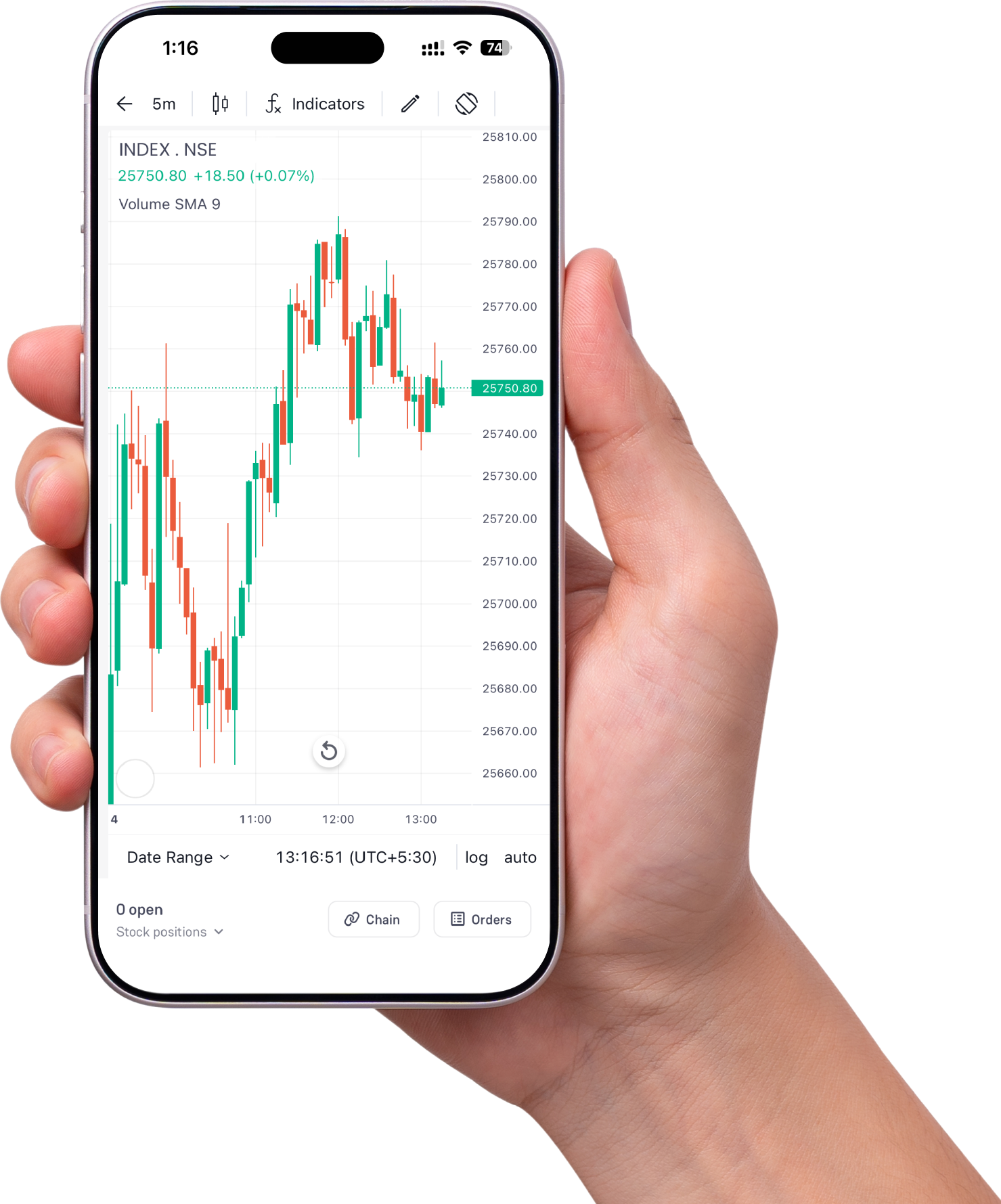
Meaning of Index in Stock Market
An index is more than just a number or percentage that frequently flashes on your
TV screens during market hours. It’s a crucial financial instrument, a barometer, providing an
overall snapshot of market performance.
For investors, both seasoned and beginners, understanding the role of an index is
essential for making informed decisions. Popular indices like Sensex and Nifty are often cited in
daily conversations, news reports, and investment analyses.
But what exactly is an index, and why is it so vital for anyone involved in the
stock market? Let’s explore.
What is Index Market?
In the stock market, an “index” refers to a statistical measure that represents
the performance of a group of selected stocks or securities. It is used to track the overall
performance of a specific segment of the market or the entire market itself.
Each index has its own method of calculation, usually either a price-weighted or a
market capitalisation-weighted method. The primary function of an index is to provide a benchmark
against which the performance of individual stocks, sectors, or even the entire market can be
measured.
For example, the S&P BSE Sensex is a market-capitalisation-weighted index
comprising 30 of the largest and most actively traded stocks on the Bombay Stock Exchange.
Similarly, the National Stock Exchange Nifty, or simply Nifty, includes 50
stocks and represents a broader section of the market than the Sensex. These indices give investors
an idea of the market’s overall direction, offering a snapshot of its health.
Indices are not just numbers but powerful tools for various purposes. They serve
as:
-
Benchmarking Tools
Investors often use indices as benchmarks to measure their own
portfolio’s performance. If your individual stock portfolio outperforms the Sensex of or
Nifty, you’re generally considered to be doing well.
-
Market Sentiment Indicators
A rising index typically indicates bullish market sentiment, while a
falling index suggests a bearish sentiment.
-
Investment Vehicles
Indices also serve as the basis for various financial products like mutual
funds and Exchange Traded Funds (ETFs). For instance, Iindex-based mutual funds aim to replicate the performance of a specific index.
-
Economic Indicators
At a broader level, indices can indicate the health of an economy. A
consistently rising stock index may suggest a booming economy, while a consistently falling
index could indicate economic trouble.
-
Risk Assessment Tools
By studying the volatility of an index, investors can assess market risk
and make more informed decisions.
Types of Index
Based on Coverage
In the financial markets, indices come in various flavours, each serving different
objectives and offering unique insights into market segments. One primary way to categorise indices
is based on their coverage.
-
Broad Market Indices
These indices, such as the Nifty 50 or S&P BSE Sensex, offer a
comprehensive market view. They include a broad range of stocks from multiple sectors,
providing a holistic sense of market direction. For instance, the Nifty 50 comprises stocks
from 12 different sectors, making it a true representative of market trends.
-
Sectoral Indices
These are more specialised and focus on specific industry sectors like
IT, Pharmaceuticals, or FMCG. The Nifty IT Index, for example, consists of major IT
companies and serves as a bellwether for the technology sector in India.
-
Thematic Indices
These indices are assembled based on particular investment themes or strategies. Examples include sustainability indices, which focus on companies with strong environmental, social, and governance (ESG) practices, and dividend yield indices, which focus on companies with high dividend yields.
Based on the Weighting Method
Another critical way to distinguish indices is through the method used to weigh the constituent stocks.
-
Price-Weighted Indices
In these types of indices, the value of the index is determined by the price of the individual stocks. The ones with higher prices have a more significant impact on the index value.
-
Market Capitalisation-Weighted Indices
The stocks are weighted according to their market capitalisation. The larger a company’s market cap, the more significant its impact on the index value. Indices like the Nifty 50 and the S&P BSE Sensex are examples of market capitalisation-weighted indices.
-
Equal Weighted Indices
All stocks are assigned the same weight in these indices, irrespective of their market capitalisation or stock price. This approach offers a balanced view but is less common than the other two methods.
Understanding the type of index you are dealing with can significantly affect your investment strategy. It can influence your asset allocation, risk assessment, and understanding of market trends.
So, it is crucial to grasp the differences among various indices in terms of
coverage and weighting methods.
Formation of Index
Creating or forming an index is not as straightforward as simply randomly picking
a few companies. It’s a meticulous process that involves several considerations, primarily focusing
on two main methods of weightage: Market Capitalisation and Price Weightage.
Market Capitalisation Weightage
-
Concept
In this method, each stock in the index is weighted according to its
market capitalisation. It is calculated by multiplying the stock’s current market price by
its total number of outstanding shares.
-
Formula
The index value is calculated using the following formula:
Index Value=(Total Market Capitalisation of Companies in the IndexBase Market
Capitalisation)×Base Index ValueIndex Value=(Base Market CapitalisationTotal Market Capitalisation
of Companies in the Index)×Base Index Value
Implications
This method gives more weight to companies with higher market capitalisation,
making the index a true reflection of market movements. If a large-cap stock experiences price
movements, it would significantly affect the index value. Most broad market indices like the Nifty
50 or S&P BSE Sensex employ this method.
Price Weightage:
-
Concept
In a price-weighted index, the value is calculated by taking the average
of the current market prices of all the stocks in the index. Here, each stock gets equal
representation, regardless of its size or volume of shares.
-
Formula
The index value is calculated using the following formula:
Index Value=Sum of Stock Prices/Number of StocksIndex Value=Number of StocksSum of
Stock Prices
Implications
This method gives equal importance to all stocks, regardless of their market
capitalisation. However, it has a drawback: higher-priced stocks can unduly influence the index,
even if they have a smaller market cap. This type of index is less common but still used in some
cases. The Dow Jones Industrial Average is a well-known example of a price-weighted index.
Understanding the method used for index formation is crucial for investors. It not
only helps in making informed decisions but also in interpreting market trends and sentiments
accurately. Whether you are a retail investor or a financial institution, understanding these
methods provides valuable insights into market dynamics and helps construct a balanced portfolio.
Purpose of Index
The index serves multiple functions in the financial markets, acting as
more than just a passive indicator. In many ways, it is the heartbeat of a market, mirroring its
ebbs and flows.
Here are some of the essential purposes of an index:
-
Benchmarking
One of the primary uses of an index is to serve as a benchmark for
investors. By comparing the performance of individual portfolios against a specific index,
investors can gauge how well they are doing. You’re generally on the right track if your
portfolio outperforms the Sensex of Nifty.
-
Market Sentiment
Indices provide a quick and efficient way to gauge market sentiment. A
rising index typically indicates a bullish market, while a falling index points towards a
bearish market.
-
Investment Products
Indices form the basis for various investment vehicles, including index
funds and Exchange
Traded Funds (ETFs). These products aim to replicate the index’s performance,
providing a low-cost and efficient investment option.
-
Economic Indicator:
Indices often act as a reflection of the economic health of a country. A
consistently high-performing index may suggest a robust economy. In contrast, a plummeting
index could indicate economic downturns.
-
Risk Assessment:
Indices also serve as tools for risk assessment. Investors can make more
informed decisions by analysing the volatility and other market parameters.
Index Investing
Index investing has gained immense popularity due to its simplicity,
cost-effectiveness, and potential for stable returns.
In index investing, you invest in a portfolio that mimics a particular index,
replicating its performance. You’re not trying to beat the market; instead, you aim to match the
market’s performance.
Here’s why index investing is advantageous:
-
Low Costs
Index investing typically has lower fees and expense ratios than actively
managed funds. You’re not paying for a fund manager’s expertise, which reduces the cost.
-
Diversification
Since indices often consist of multiple stocks from various sectors,
investing in an index naturally provides diversification, reducing the risk.
-
Transparency
Index funds are straightforward. You know exactly what you’re investing
in, as the fund mimics a publicly available index.
-
Consistency
While actively managed funds may outperform the market occasionally, they
rarely do so consistently over long periods. Index funds offer a more consistent
performance.
Examples
-
Nifty 50 Index Fund
This fund seeks to mirror the performance of the Nifty 50, providing
exposure to the 50 largest and most liquid Indian companies.
-
S&P BSE Sensex Index Fund
This fund aims to replicate the S&P BSE Sensex, which consists of 30
of the largest and most actively traded stocks on the Bombay Stock Exchange.
-
Sectoral Index Funds
These funds target sectors like IT, healthcare, and utilities. For
instance, a Nifty IT Index Fund would invest in the top IT companies in India.
-
Global Indices
Some index funds aim to replicate global indices like the S&P 500,
exposing investors to international markets.
Basics of Index-Linked Investment Products
Index-linked investment products are financial instruments that aim to replicate
the performance of a specific market index.
These products allow investors to invest in the broader market or specific sectors
without picking individual stocks.
Here’s a detailed look at the basics of index-linked investment products:
-
Types:
Index Funds and Exchange-Traded Funds (ETFs) are the most common
index-linked investment products. Index Funds are mutual funds that mimic the portfolio of a
specific index. On the other hand, ETFs are traded on stock exchanges and offer real-time
pricing, unlike traditional mutual funds priced at the end of the trading day.
-
Cost-Effectiveness
These products are generally less expensive than actively managed funds.
They have lower expense ratios and fewer transaction costs, making them more accessible for
the average investor.
-
Diversification
Index-linked products usually comprise multiple stocks, offering a
diversified investment option. This diversification can help mitigate risks associated with
investing in individual stocks.
-
Passive Management
These products are passively managed, aiming to replicate the index’s
performance rather than outperform it. This approach eliminates the need for active
management, thereby reducing costs.
-
Liquidity
ETFs offer higher liquidity than index funds as they can be bought and
sold on stock exchanges during trading hours at market prices.
-
Tax Efficiency
Due to their passive nature, index-linked products often have fewer
capital gains distributions, making them more tax-efficient than actively managed funds.
Why is Monitoring Index Important?
Monitoring the index is not just a routine for day traders or financial analysts.
It’s a critical activity for anyone involved in the investment world.
Here are some compelling reasons why monitoring an index is important:
-
Informed Decision Making
Keeping an eye on the index helps you make informed decisions about
buying, selling, or holding assets. It provides a quick market sentiment overview, helping
you gauge whether it’s a bull or bear market.
-
Benchmarking:
Tracking an index lets you compare your portfolio’s performance against a
standard measure. If your investments are consistently underperforming the index, it might
be time to re-evaluate your strategy.
-
Risk Assessment
Indices often exhibit patterns and volatilities that can be studied for
risk assessment. Understanding these patterns can help you adjust your investment strategy
to mitigate potential losses.
-
Investment Planning
Knowing the trends in indices can help in long-term investment planning.
For example, suppose a particular sector is consistently outperforming the broader market.
In that case, you might consider increasing your investment in that area.
-
Global Perspective
Many investors also track global indices to understand international
market trends. This information can be particularly useful for those who have or are
considering foreign investments.
-
Economic Indicators
Indices are often considered as economic indicators. A consistently
rising index may indicate a booming economy, while a falling index could signify economic
troubles.
-
Asset Allocation
Monitoring indices can also guide you in asset allocation. For instance,
you might want to shift more into growth stocks or other asset classes like bonds during a
bear market.
-
Real-time Updates
With modern technology, you can monitor indices in real-time, giving you
the ability to make immediate investment decisions based on current market conditions.
What Are Some Major Stock Indexes in the World?
The world of finance is filled with various stock indexes that act as barometers
for different markets, sectors, and investment themes.
Here are some major stock indexes that are often cited:
-
S&P 500
Based in the United States, this index includes 500 of the largest
companies listed on stock exchanges in the United States. It is one of the most commonly
followed equity indices. It is considered to be the best indicator of the U.S. stock market.
-
Dow Jones Industrial Average (DJIA)
Another U.S.-based index, the DJIA comprises 30 large publicly-owned
companies in the United States. It is one of the oldest and most-watched indices globally.
-
Nasdaq Composite
This index includes all the companies listed on the Nasdaq stock
exchange. While heavy on technology stocks, it includes companies from other sectors.
-
Nikkei 225
Representing the Japanese stock market, this index includes the top 225
companies listed on the Tokyo Stock Exchange.
-
FTSE 100
Known as the “Footsie,” this index represents the 100 largest companies
listed on the London Stock Exchange.
-
DAX
This index includes the 30 major German companies trading on the
Frankfurt Stock Exchange.
-
S&P BSE Sensex
An index of 30 companies listed on the Bombay Stock Exchange, the Sensex
is often considered the pulse of the Indian stock market.
-
Nifty 50
Another key index in India, the Nifty includes the top 50 companies
listed on the National Stock Exchange.
-
Shanghai Composite:
This index includes all the A and B shares listed on the Shanghai Stock
Exchange, providing a comprehensive view of the Chinese stock market.
-
CAC 40
This French index includes the largest 40 companies listed in France.
Some Important Terms Related to Index
When discussing indexes, several key terms come into play. Understanding these can
enhance your grasp of how indexes function and their role in investment:
-
Bond Index
Unlike a stock index, a bond index tracks the performance of a particular
set or category of bonds. Examples include the Bloomberg Barclays U.S. Aggregate Bond Index.
-
Index Fund
This type of mutual fund is designed to replicate a specific index’s
performance. It offers a passive investment strategy, usually with lower fees than actively
managed funds.
-
Index Numbers
These are statistical measures representing the relative change in a
particular variable, such as price or quantity, over time. They are often used in economic
analyses.
-
Market-Capitalisation Weighted Index
Each stock is weighted based on its market capitalisation in this type of
index. The larger the company, the more significant its impact on the index.
-
Price-Weighted Index
Each stock’s price determines its weight in the index. Stocks with higher
prices have a more significant influence on the index value.
-
Equal-Weighted Index
All constituent stocks are given equal weight, irrespective of their
market capitalisation or stock price.
-
Volatility Index
Often called the “fear gauge,” this index measures market risk and
investor sentiment. The VIX is a popular example.
-
Composite Index
This index includes multiple asset classes, such as stocks and bonds, to
provide a more comprehensive view of market performance.
-
Sector Index
This index focuses on a specific industry or sector, like technology or
healthcare, and includes companies operating in that sector.