How to Use India VIX and Implied Volatility Before Buying or Selling Options?
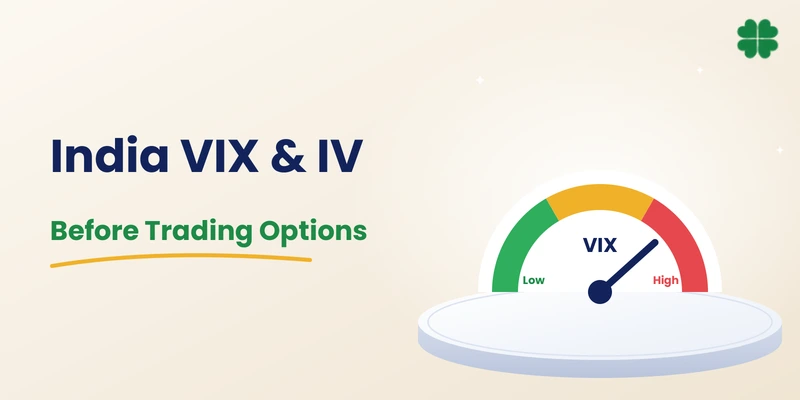
India VIX and implied volatility show how much movement the options market expects, and both affect the price of every option. A trader who ignores them may pay too much for a call or sell a put at too little premium. Reading them before a trade helps in choosing between buying and selling, and in setting the size of the position. However, neither measure indicates the market’s direction. Instead, they reflect the expected extent of price fluctuations, without predicting whether prices will rise or fall.
What is India VIX?
India VIX is a volatility index published by NSE. It is calculated from the prices of NIFTY options and shows the volatility that the market expects over the next 30 calendar days, quoted on an annual basis. It is often called the fear indicator because it tends to rise when markets fall sharply and fade when markets are calm. It differs from the broader idea of volatility in the stock market.
What is Implied Volatility?
Implied volatility is the volatility built into an option’s price. It is calculated by working backwards from the option premium using an option pricing model, such as Black-Scholes. A higher implied volatility means a more expensive option premium, and a lower one means a cheaper option, with other factors unchanged.
India VIX is a weighted measure of expected volatility derived from NIFTY option pries, whereas each individual stock or index option has its own implied volatility. Historical volatility, by contrast, measures the price movement that has already happened.
Converting India VIX into an Expected Move
India VIX can be turned into an estimate of the expected price range. Since India VIX is quoted as annualised volatility, the approximate expected move can be calculated using the following formulas:
One-month expected move = India VIX ÷ √12
One-day expected move = India VIX ÷ √365
At a VIX of 15, the one month expected move is about 4.3%, and the one day expected move is about 0.9%.
On a NIFTY level of 24,000, this means approximately 1,040 points for a month and 227 points for a day. The figures are illustrative, describe a range that is expected about two times in three, and do not predict direction.
Using India VIX Before Buying Options
Option trading by buyers depends on paying a fair price for movement. When India VIX is high, premiums are expensive, and the market must move more than expected for a buyer to profit. When it is low, premiums are cheaper, which can suit buyers who expect a sudden move.
Buyers should also watch for events such as results, RBI policy and Union Budget, because implied volatility often falls sharply once the event is over. This fall, often called volatility crush, can reduce the premium even when the price moves in the expected direction.
Using India VIX Before Selling Options
Sellers earn the premium, so higher implied volatility improves the premium available for selling options. The risk is that high volatility also means larger price swings, and a sharp move can lead to losses well above the premiu m collected.
Margin requirements can also rise when volatility rises because exchanges and brokers may adjust risk and margin requirements. However, the actual margin depends on the position, applicable margin rules and market conditions.The skew across strikes is covered under volatility skew. Many sellers prefer spreads, which cap the loss, over unhedged positions. A risk review for options trading should come before any selling strategy.
IV Rank and IV Percentile
A VIX reading means little without context. A value of 15 may be low in one year and high in another. IV rank and IV percentile compare the current implied volatility with its historical levels, which helps show whether options are relatively expensive or inexpensive compared with their own history. Understanding implied volatility, IV rank and IV percentile may help traders to compare current volatility with past levels.
Volatility in the Stock Market and Strategy Selection
Volatility in the stock market moves in cycles. Periods of low volatility are often followed by sharp rises, and high volatility tends to settle. A simple framework matches strategy to the volatility level:
- Low VIX and low IV rank: Long calls, long puts or straddles may be considered, since premiums are cheaper.
- High VIX and high IV rank: Spreads and defined risk selling strategies may be considered, since premiums are richer.
- Rising VIX: Hedging a portfolio with puts may be considered.
- Falling VIX: Selling strategies may become more attractive, with strict stop losses.
Common Mistakes
Traders often treat VIX as a signal of market direction, which it is not. A rising VIX shows that uncertainty is increasing, not that the market will fall. Others compare VIX with a fixed number and ignore historical levels. Some buy options before events at peak implied volatility and then lose on the volatility crush. Position size and exit rules matter more than the volatility reading itself.
Option chain analysis can add context by showing where premiums and open interest are concentrated. Traders who also use futures and options together should know about derivatives trading and the options trading offering.
Conclusion
India VIX and implied volatility help a trader judge whether options are cheap or expensive and how large a move the market expects. They do not predict direction. Used together with IV rank, event dates and proper risk controls, they support better decisions on buying or selling options.
FAQs
What is India VIX?
India VIX is a volatility index published by NSE that is based on NIFTY option prices. It shows the volatility the market expects over the next 30 days and is quoted on an annual basis. It is often read as a measure of fear or comfort in the market.
What is the difference between India VIX and implied volatility?
India VIX is a single index that measures expected volatility using a weighted calculation based on NIFTY options prices. Implied volatility is specific to each option, and it varies by strike price, expiry and underlying. Both reflect the market’s expectations of future price fluctuations, but they are not interchangeable.
Should options be bought when India VIX is high?
Buying is more expensive when India VIX is high, because option premiums carry higher implied volatility. A buyer needs a larger move to recover the premium and make a profit.A volatility crush after an event can reduce the premium. Spreads can lower the cost, and smaller position sizes can limit the potential loss.
Is high India VIX good for option sellers?
High India VIX boosts premiums and thus improves income for sellers. That also means bigger moves and higher margin needs; thus the risk is bigger. Defined-risk tactics like spreads restrict the loss and a stop loss must be specified before entering.
Does a rising India VIX mean the market will fall?
Not necessarily. A rising India VIX means the market predicts a bigger move and it frequently rises when markets decline. It does not give direction thus it should be read with price action, scheduled events and the option chain before a trade is performed.