

- Real Time Market Data
- Smart Risk Management
Trade with Strategy Not Speculation
Empower your options trading with advanced data, real-time analytics and built-in risk management tools for every market trend.
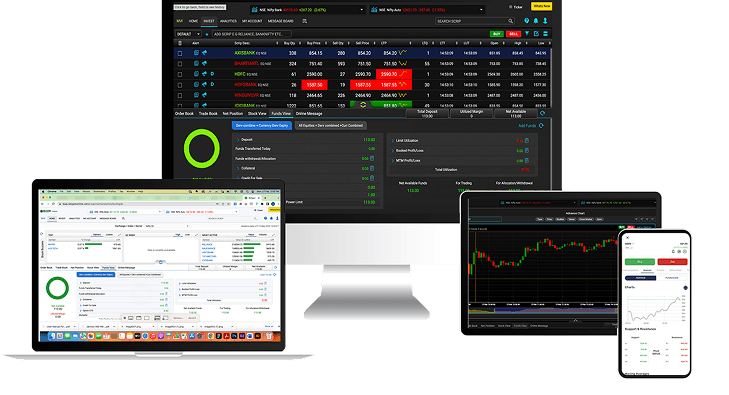
When Markets Move, Make It Work for You
Access markets with advanced tools built to help you analyze trends, control risk and execute smarter strategies.

Advanced Option Chain
Deep-dive with real-time data. Analyze price sensitivity, volatility and liquidity across all strikes for the right entry.

Multi Leg Orders
Speed is your strategy. Execute high-momentum, multi-leg orders with a single click to capture rapid market shifts.

Trending Open Interest
Track OI to gauge market. Identify where money is moving across the selected strikes over last 60 minutes.
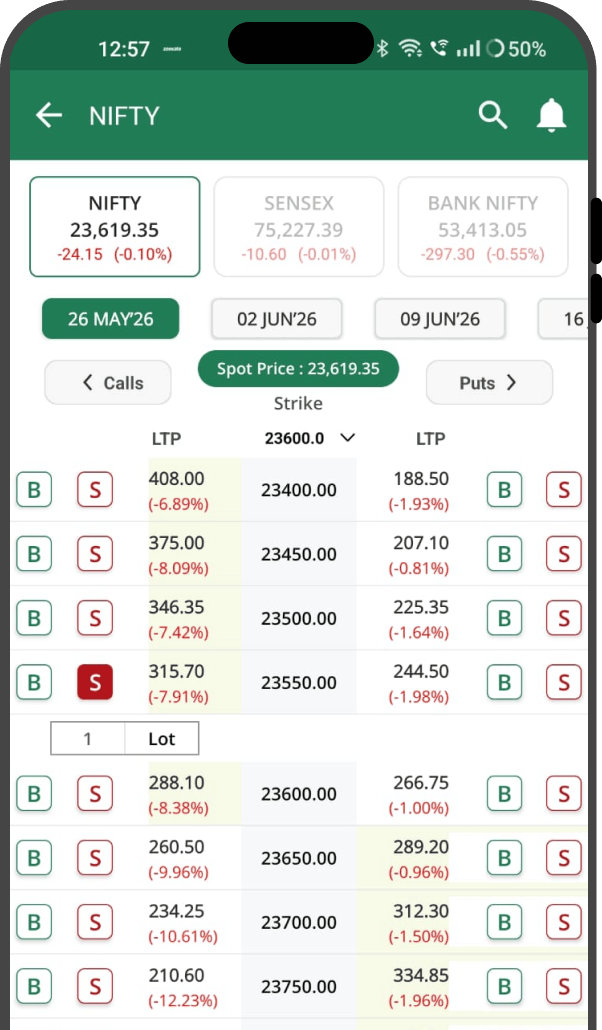

Combined Premium Chart
Visualize risk before you commit. Monitor total costs and combined premiums of multi-leg strategies.

Smart Strategies
Optimise strategies. Choose the one that matches with your market outlook: positive, negative, or neutral.

Margin and Stock Pledging
Pledge your existing holdings and unlock additional collateral margin for futures positions without selling your assets.
Most Active Contracts
Track contracts with the highest open interest build-up
Symbol↕ | LTP↕ | Strike Price↕ | Call/Put↕ | Contracts↕ | OI%↕ | Build up↕ |
|---|
Features of Our Trading Platform
Smart, intuitive features to enhance your trading experience.

Instant Account Opening

Fully Integrated Trading Platform

In depth Research Expertise

Advanced Screeners and Charting Tools
How to Do Option Trading with Religare
Access a seamless trading platform, live market data, and advanced tools—all in one place.

Account Activation
Open your account, complete the KYC process, e-sign and unlock the Equity Derivatives (FnO) segment across all exchanges instantly.

Add Funds
Transfer funds securely to meet your initial margin requirements. Use margin calculators to evaluate your capital efficiency and buying power.

Execute Orders
Use advanced charts to identify market direction. Place Long or Short orders with a single click across stocks, indices, or commodities.

Track and Manage
Monitor real-time MTM (Mark-to-Market) and margin status. Set stop-loss triggers to manage risk and exit positions at the right time.

Why Choose Religare Broking?
We combine three decades of trust with advanced technology for seamless execution. Our clients trade with absolute confidence, backed by professional research and market insights.

30+ Years
of Trust

All-in-One,
Web and Mobile Platform

1300+
Touch Points

Client Centric
Approach
Understanding Options Trading
Essential guide to options trading, types and strategies
What is Options Trading?
Options trading is a type of derivatives trading that gives the buyer the right, but not the obligation, to buy or sell an underlying asset at a pre-determined price (called the strike price) on or before a specified expiry date, depending on the contract type. To acquire this right, the buyer pays a premium to the option seller. In India, options trading is available on exchanges such as the NSE and BSE, with contracts on stock indices like Nifty 50, Nifty Bank (Bank Nifty), and selected individual stocks. While equity trading allows you to buy and own the underlying shares outright, options give you a right over the asset without requiring the full upfront investment.
How Does Options Trading Work?
Every options contract works around a few key elements
- Strike Price: The fixed price at which the underlying asset can be bought (call) or sold (put) if the option is exercised is called strike price.
- Premium: It is the price you pay to buy an option. This is your maximum possible loss as a buyer.
- Expiry Date: Options have a fixed expiry (weekly or monthly, depending on the contract), after which they either get exercised, settled in cash, or expire worthless.
- Lot Size: Like futures, options trade in exchange-defined lot sizes, not individual units.
When you buy a call option, you are betting the price will rise above the strike price before expiry. When you buy a put option, you are betting it will fall below the strike price. If your view does not play out, your loss as a buyer is limited to the premium paid; this defined-risk structure is one of the key differences between how option trading works compared to futures trading.
Option Trading Time in India
Currently Options trade on NSE and BSE during the same hours as the equity cash market, i.e, 9:15 AM to 3:30 PM, Monday to Friday, with a pre-open session from 9:00 AM to 9:08 AM.
From August 3, 2026, NSE is extending the equity derivatives segment's closing time from 3:30 PM to 3:40 PM. This applies uniformly to index options, stock options, index futures and stock futures. The change is being introduced alongside a new Closing Auction Session (3:15 PM–3:35 PM) in the cash equity market, and gives options traders 10 additional minutes to react to the final closing-price discovery in the underlying stock or index before their positions close for the day. The market open time (9:15 AM) and pre-open session remain unchanged.
Types of Options Trading
Always navigate market trends with clarity and confidence. You can begin your options trading journey with following Options trading strategies:
- Call Options: Get the right, not the obligation, to purchase an asset at a fixed price in a given period of time; best during bullish markets, i.e. when you anticipate the price will increase.
- Put Options: Get the right, not the obligation, to sell at a fixed price. This strategy is used to profit from declining markets or to hedge against the loss in an existing portfolio.
- Index Options: Here, traders trade on broad market movements such as Nifty or Bank Nifty rather than a specific stock.
- Stock Options: Take specific positions on individual company stocks, allowing the individual stock performance to be used as a target.
Let’s understand Options Trading with an example.
Suppose a stock is trading at ₹1,000. You buy a call option with a strike price of ₹1,050, expiring in one month, by paying a premium of ₹20 per share (say, for a lot size of 500 shares, your total premium outlay is ₹10,000).
If the stock rises to ₹1,100 before expiry, your option is now worth at least ₹50 (₹1,100 − ₹1,050 strike price), giving you a potential profit of ₹30 per share after accounting for the premium paid, before other costs like brokerage and taxes.
If the stock stays below ₹1,050 at expiry, the option expires worthless, and your loss is limited to the ₹10,000 premium you paid — no matter how far the stock falls.
Please note, this is just an example of options trading for illustration purpose. Actual outcomes depend on real market prices, volatility, brokerage, and taxes.
Core Features of Options Trading
- No Obligation for buyers: Option buyers have the right, but not the duty, to purchase (call) or to sell (put) an asset at a given price. This provides them strategic flexibility to execute the trade, depending on evolving market conditions.
- Defined risk for buyers: As an options buyer, only the amount paid as a premium, is your potential loss. While, the profits can vary, basis price fluctuations.
- Leverage: Options enable traders to take a large position at a relatively low upfront investment as premium.
- Time decay (theta): The options have an expiry date; their value tends to decrease as the expiry date approaches. This time decay is a significant aspect which traders should take into account when planning trades.
- Hedging instrument: The most popular approach to hedge an existing investment against market fluctuations is by means of options. They are similar to insurance and help minimize potential losses in uncertain or volatile situations.
- Liquidity and flexibility: Options that are actively traded are very liquid, and therefore, one can easily get in and out of a position. A large number of strategies like Spreads, Straddles, and Strangles are also available to traders to take advantage of various market situations.
How to Trade Options?
Here is a Step-by-Step guide for beginners, the ones who are exploring how to trade in options for the first time.
- Open a trading and demat account with a SEBI-registered broker like Religare Broking Ltd and activate the F&O segment.
- Learn the basics of strike price, premium, expiry and lot size before placing your first trade.
- Decide your market view (bullish, bearish, or range-bound) and choose a call or put option accordingly. Always keep position size proportional to capital you can afford to lose.
- Place your order through your broker's platform, and track time decay (theta). An option's value tends to erode as expiry approaches, even if the underlying price doesn't move much.
- Exit before expiry or let the contract settle, keeping in mind that very short-dated (weekly) options can see sharp premium swings in the final sessions before expiry.
For trading options for beginners, it's generally advisable to start by buying options (where your maximum loss is capped at the premium) rather than selling/writing them (where losses can be substantially larger), and to use small position sizes while you learn how premium, time decay and volatility interact.
Options Trading Tax in India
Profits from options trading are taxed as non-speculative business income, not capital gains, and added to your total income at your applicable slab rate. Most traders must file ITR-3.
Since Budget 2026, STT on options is 0.15% of the premium (sell side) and 0.15% on intrinsic value if exercised, effective April 1, 2026. Turnover for tax purposes is the sum of absolute profit/loss on each trade plus premium received on options sold.
A tax audit may apply depending on your turnover and profit-to-turnover ratio, thresholds vary, so confirm with your CA. Losses can be carried forward for 8 years if ITR is filed on time, and trading costs like brokerage and STT are deductible as business expenses.
Trade Anytime,
Anywhere
Experience India's seamless trading app with advanced features, intuitive design, and lightning-fast execution.
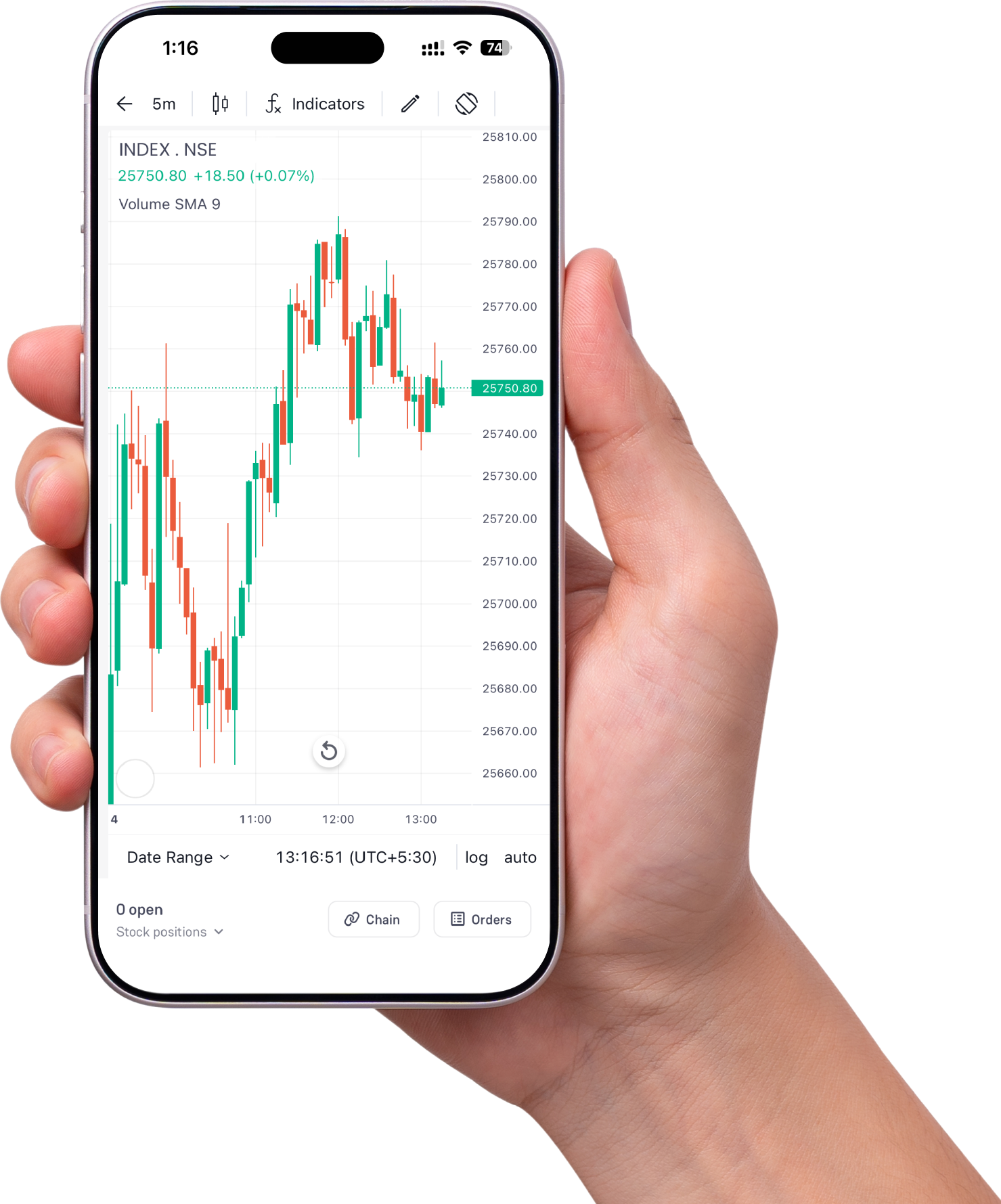
Unified Portfolio
All Assets, One App
Instant Market Alerts
Live Research, Zero Delay
Seamless Security
Biometric Login for Safe Trading
Actionable Ideas
Pre-built Options Strategies
Based on 27.4K reviews
1M+
Downloads