Options lose value as their expiry approaches. A calendar spread uses this to a trader’s advantage by combining two options on the same underlying, one with an earlier expiry and the other with a later expiry. This strategy suits traders who expect little price movement in the short term and want to limit their potential loss.
What is Calendar Spread?
A calendar spread involves two options of the same type and strike but with different expiry dates. In a normal long calendar spread, the trader sells one option whose expiration is closer and buys another with a longer expiration period. The strategy focuses on changes in option value over time rather than large price movements in the underlying. If different strikes are used, a diagonal spread will be formed, while reversing the trades creates a reverse calendar spread.
Calendar Spreads Options: How the Position Works
Most calendar spread options strategies use the long calendar approach. Here, the nearer expiry option loses time value faster than the later one, and the trader aims to benefit from this difference. The later option is also more sensitive to implied volatility, so a rise in volatility generally helps the position, while a fall can work against it. Time decay and volatility are measured by the Options Greeks.
Calendar Spread Strategy: Setup and Market View
The calendar spread strategy is more suitable when the underlying is expected to stay near the chosen strike until the near expiry. The money strikes are common, since that is where time decay on the short option is strongest. Volatility that is low relative to its own history at entry is also considered favourable.
Put Calendar Spread
A put calendar spread involves buying a longer-dated put and selling a shorter-dated put at the same strike price, for a net debit. It works well when the trader expects the price to stay close to the strike. The maximum risk is limited to the net debit and transaction charges. The short put profits from time decay and the long put profits from a rise in implied volatility. This technique is designed for traders who are neutral to somewhat bearish on the market.
Calendar Spread Option Strategy: A Worked Example
The following calendar spread option strategy example uses assumed premiums and a Nifty lot size of 65, applicable to the revised contracts from January 2026. Actual premiums in derivative may differ.
| Leg |
Action |
Premium per unit |
Value for 65 units |
| Near expiry 25,000 call |
Sell |
₹80 received |
₹5,200 |
| Later expiry 25,000 call |
Buy |
₹200 paid |
₹13,000 |
| Net debit |
|
₹120 |
₹7,800 |
The net debit of ₹7,800 is the most the trader can lose before charges. If the index closes near 25,000 at the near expiry, the short call may lose most of its value, while the long call may retain time value. The trader can then close or adjust the remaining position.
If the index moves far above or below 25,000, both options move towards the same value and the spread narrows, so the loss can approach the debit.
Option Calendar Spread Strategy: Payoff Shape
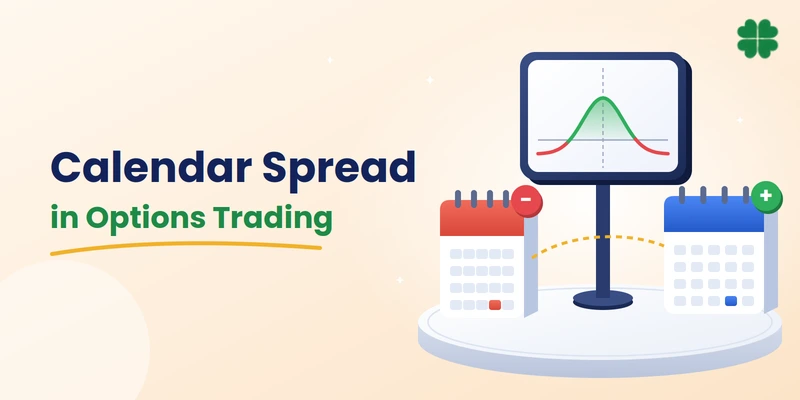
The payoff of a calendar spread usually looks like a tent or hill. The profit is generally highest near the strike price and decreases as the market moves further away, eventually turning into a loss. Maximum profit is not fixed as it relies on the value of the later option at the nearer expiry which is determined by implied volatility, the underlying price and time remaining to expiry. The break-even points can also change as volatility changes.
Margin on Calendar Spreads
In derivatives trading, brokers normally charge smaller margins on calendar spreads because the long option hedges the risk of the short option. However, SEBI has given this relaxation for equity index derivatives that expire on the same day.
In its circular dated 1 October 2024, the margin benefit was withdrawn with effect from 1 February 2025. This means the short leg is now handled as a standalone position for margin computation on expiry day. For example, a hedged position that normally requires ₹50,000 may need ₹1 lakh on expiry day. A margin shortfall may also lead to positions being squared off after 1 PM on the previous day.
Since margin requirements can change, traders should check the latest figures with their broker before entering a trade.
Risks of Calendar Spreads
The risks of calendar spreads in options trading are specific and worth listing before any trade.
- A sharp move away from the strike can push the loss towards the full debit.
- A fall in implied volatility can reduce the value of the later option even when the index stays still.
- Finishing exactly at the strike does not guarantee a profit.
- Leaving the long leg open after the short expires leaves a plain bought option.
- Legs placed or exited separately can leave an unintended position, and charges apply to all four orders.
Traders who also roll futures positions can benefit from understanding futures trading and how these contracts work.
Conclusion
A calendar spread combines a short near month option and a long later month option at the same strike. The position gains from faster time decay in the near option. The loss is limited to the net debit, but a sharp move away from the strike or a fall in implied volatility can reduce its value. Margin, charges on every leg and expiry day rules should be checked before entry. Traders can open a Demat account with Religare and enable the derivatives segment to place these spreads.
FAQs
Is the maximum loss in a calendar spread limited?
Yes. For a long calendar spread the maximum loss is the net debit paid, before brokerage and other charges.
Which market view suits a calendar spread?
A neutral view, where the underlying is expected to stay near the strike until the near expiry.
How does implied volatility affect the position?
A rise after entry tends to help, because the later option has more sensitivity to volatility. A fall can reduce the position’s value.
Do calendar spreads get a margin benefit?
Generally yes, but the benefit does not apply on the expiry day of the contracts involved, so margin rises that day.
Can I use puts instead of calls?
Yes. A put calendar spread buys a later dated put and sells a nearer dated put at the same strike.