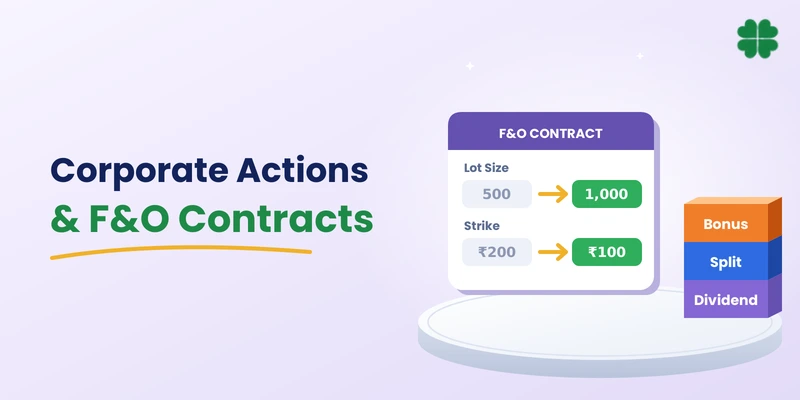
When a company announces a bonus, a split or a rights issue, the shares change but a futures or options contract on those shares is still open. Exchanges handle this by adjusting the contract so that its value stays fair to both sides. Without that step, a trader could gain or lose money only because the share count changed. The adjustment applies to the strike price, the lot size or both, depending on the type of event.
Why Exchanges Adjust Contracts
A corporate action adjustment in F&O keeps the economic value of an open position the same before and after the event. Adjustments are made the day before the ex date, when the market closes, and can change the futures base price, the option strike prices and the market lot. The aim is not to give traders a gain or a loss, but to leave the contract value neutral. The adjustment applies to every open futures contract on the affected stock.
F&O Adjustment for Corporate Actions: What Changes
The F&O adjustment for corporate actions changes three things: the futures price used for settlement, the strike prices of options, and the lot size. The table below shows the broad direction of each change.
| Corporate action |
Futures price and strike |
Lot size |
| Bonus issue |
Divided by the adjustment factor |
Multiplied by the factor |
| Stock split |
Divided by the adjustment factor |
Multiplied by the factor |
| Rights issue |
Multiplied by a factor below one |
Divided by the factor |
| Extraordinary dividend |
Futures base price adjusted by the aggregate dividend; option strikes Reduced by the dividend amount |
Unchanged |
| Merger |
Contracts are compulsorily settled on the last cum-trading day |
Not applicable |
| Demerger |
Adjusted or closed as specified in the relevant exchange and clearing corporation circular |
As specified in the relevant circular |
Bonus Issue Adjustment in Futures and Options
The bonus issue adjustment in futures and options uses a simple ratio. For a bonus share of A:B, the factor is (A+B)/B, so a 1:1 bonus gives a factor of 2; the futures price and strikes are divided by it, and the lot size is multiplied by it.
| Item |
Before |
After a 1:1 bonus |
| Futures price |
₹1,200 |
₹600 |
| Strike price |
₹1,200 |
₹600 |
| Lot size |
250 |
500 |
| Contract value |
₹3,00,000 |
₹3,00,000 |
The contract value does not change, which is the purpose of the adjustment. The same logic applies to the strikes of every listed stock option.
What Happens to F&O Positions on Stock Split
Traders often ask what happens to F&O positions on a stock split. The position continues, and the exchange adjusts the contract in the same way as for a bonus. For a split of A:B, the factor is A/B, so a 5:1 split gives a factor of 5, with the futures price and strikes divided by it and the lot size multiplied by it.
A futures price of ₹2,000 would become ₹400, a ₹2,000 strike would become ₹400, and a lot of 100 would become 500, leaving the contract value at ₹2,00,000. A reverse stock split, where shares are consolidated, is adjusted in a similar way in the opposite direction.
Rights Issue Adjustment
A rights issue is more complex because new shares are offered at a discount and the price adjusts differently. The adjustment factor depends on the cum date closing price and the value of the rights entitlement, and it is below one. The futures price and strikes are multiplied by the factor, and the lot size is divided by it.
Dividends
Most dividends do not cause any change. Only extraordinary dividends, where the dividend amount exceeds 2 percent of the market value of the underlying stock, are adjusted. In that case, the futures price and option strike prices are reduced by the dividend amount, and the lot size stays the same. Fo example, a ₹3 dividend would reduce a futures price from 99.3 to 96.3 and a 110 call strike to 107. Regular payouts are covered under interim dividends.
Mergers and Demergers
Mergers and demergers are treated differently from the other actions. For a merger, no fresh futures or options contracts are introduced on the stock after the merger’s record date is announced. Existing unexpired contracts are compulsorily settled on the last cum-date at the specified settlement price, based on the underlying stock’s closing price on that day.
For a demerger, the treatment depends on the specific restructuring scheme and the applicable exchange and clearing corporation circular. The exchange may prescribe adjustments to existing positions, compulsory closure or the introduction of revised contracts. Therefore, it is not correct to assume that all open positions automatically close before the ex-date and that new contracts are always introduced on the ex-date. Traders should read the exchange circular for each case, since the terms depend on the scheme and on the rules of derivatives trading.
Impact on Traders
Even a corporate action adjustment in F&O that keeps value unchanged has practical effects. A larger lot size can raise total exposure and margin requirements, option premiums can swing sharply, volatility often rises and liquidity may dip temporarily. Spreads and hedges need special care, because the legs may be adjusted differently and may no longer offset each other as before.
What Traders Should Do
Traders should follow corporate actions NSE F&O adjustments through exchange circulars and check the ex date for every stock in which a position is held. After the adjustment, the new strike, lot size and contract code should be confirmed, and margin should be checked again.
Every contract adjustment F&O traders see follows the same principle. Comparing the contract value before and after is a quick test of whether the numbers are right. Investors who hold the underlying equity shares see the same ex date in their holdings, where the share price itself adjusts.
To Sum Up
Exchanges adjust futures and options when a company announces a bonus, split, rights issue, or similar event, so that the contract value remains fair to both sides. The strike, lot size and contract code may change, and margin should be checked again afterwards. Exchange circulars and the ex date for each stock help traders keep their positions in order.
FAQs
When are F&O contracts adjusted for a corporate action?
Adjustments are made after the close of trading on the last cum-trading day in the underlying equity market, generally the day before the ex date.
Does the value of my position change after a bonus or split?
No. Prices and lot size move in opposite directions, so the contract value stays the same.
Is every dividend adjusted in F&O?
No. Only extraordinary dividends of 2% or more of the market value of the underlying are adjusted.
What happens to F&O contracts in a merger?
Existing contracts close at the end of the day before the ex date, and open positions are settled.
Where can I find the adjusted contract details?
Exchange circulars and your broker’s platform show the new strike, lot size and contract code.