

- Real Time Market Data
- Multi Asset Dashboard
Trade Equity with Confidence
A research backed platform for long-term investing and intraday opportunities
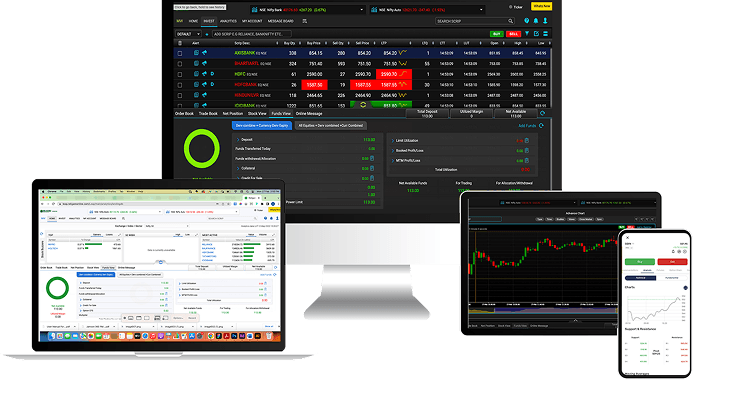
Get Empowered, Trade with Conviction
Clarity in every decision. Momentum in every order

Expert Research
Receive daily trading strategies and fundamental insights from our experienced research team

Advanced Trading Tools
Master your entries with advance tools and integrated stock scanners to identify trading opportunities

Single-Screen Trading
Execute trades directly from charts while tracking your real-time PnL in one view on the platform


Margin Trade Funding (MTF)
Increase your buying power with MTF facility, paying only a fraction of the total trade value

Call n Trade
Never miss a market move due to poor connectivity. Execute trades instantly via Call and Trade desk

Set Alerts
Never miss trading opportunities by setting alerts on price, volumes and support levels to get notified instantly.
Features of Our Trading Platform
Smart, intuitive features to enhance your trading experience.

Instant Account Opening

Fully Integrated Trading Platform

In depth Research Expertise

Advanced Screeners and Charting Tools
How to Trade in Equity Markets?
Join a community of informed investors with a seamless, paperless onboarding process. Complete these 4 steps to activate your account.

Open Account
Open your account, complete the paperless KYC process and unlock Equity segment across all exchanges instantly.

Analyse Markets
Explore thousands of stocks across NSE and BSE. Access research reports and real-time market data.

Invest and Trade
Choose your stocks, select your preferred order type, and execute trades instantly with one tap.

Track Growth
Monitor performance and manage risk of portfolio on an intuitive dashboard using stop loss and fundamental indicators.

Why Choose Religare Broking
We combine three decades of trust with advanced technology for seamless execution. Our clients trade with absolute confidence, backed by professional research and market insights.

30+ Years
of Trust

All-in-One,
Web and Mobile Platform

1300+
Touch Points

Client Centric
Approach
Your Guide to Equity Trading in India
Navigate markets with expert insights. Access essential strategies for portfolio growth, risk control and capital optimization
Equity trading in India involves buying and selling company shares through registered stockbrokers on recognised stock exchanges such as the National Stock Exchange (NSE) and the Bombay Stock Exchange (BSE). Every transaction is subject to exchange processes, settlement and tax regulations. Equity trading is different from trading on equity, a corporate finance concept in which a company uses borrowed funds to potentially increase returns for its shareholders.
What is Equity Trading
In simple terms, equity trading means buying and selling company shares through a recognised stock exchange. These shares represent partial ownership in a company, via an established stock market. In order to buy and sell these trades, an investor requires two accounts; a demat account to store the shares in a digital form and a trading account to place buy and sell orders through a stockbroker.
The NSE and BSE trade equity shares digitally through screen-based trading and order-matching systems. Buyers and sellers place orders at their bid and ask prices, which the system automatically matches when the prices align.
How Equity Trading Works
A trader places an order with a broker, specifies the number of shares, and selects a market or limit order.
The exchange matches the order with a compatible opposing order to execute the trade.
Indian exchanges follow a T+1 settlement cycle, under which shares are credited to the buyer’s demat account and funds are credited to the seller’s linked bank account within one working day of the trade.
Brokerage, exchange transaction charges, Securities Transaction Tax and stamp duty are charged during the transaction, regardless of whether the trade ultimately turns a profit.
Types of Equity Market
Equity markets are structured around two distinct platforms. These two types of equity market determine how companies raise capital and how investors trade existing shares.
- Primary market: A company planning to offer its shares to the public may launch an Initial Public Offering, through which it can raise capital by issuing new shares. Once the IPO closes, the stock gets listed on a stock exchange for further trading.
- Secondary market: Once shares are listed on an exchange, the existing investors can sell their holdings, while investors who missed the IPO can buy instead. The secondary market covers shares and other securities, including convertible bonds and corporate bonds. Investors usually trade these securities through intermediaries known as stockbrokers.
Types of Equity Trading
Not every equity trade follows the same timeline, and the type of equity trading an investor chooses influences both the level of risk and the time and attention required.
- Momentum trading: Trading stocks that are experiencing high movement in a certain direction and following the trend in order to make instant gains.
- Swing trading: Holding positions of a few days or weeks to gain profits from short to medium term price movements, often using technical analysis to identify potential entry and exit points.
- Scalping: Making multiple short duration trades to capture small price movements.
- News based trading: Trading on news of a company, government policy or international events that may affect stock prices.
- Arbitrage: Capitalising on price differences for the same stock across markets to seek relatively low-risk profits.
- Long term position trading: Purchasing fundamentally and technically good companies and holding them for months, with the aim of benefiting from longer-term price movements.
Tax on Equity Trading
The tax on equity trading is based on the type of activity and the tax regulations. In the case of qualifying listed equity shares that are treated as capital assets, any short-term capital gains on sales subject to STT will be taxed at 20% when transferred on or after 23 July 2024. Long-term capital gains on qualifying shares held for more than 12 months are taxed at 12.5% on aggregate eligible gains exceeding ₹1.25 lakh in a financial year. If trading income is classified as business income, different tax rules may apply.
Risks of Equity Trading
There are various market risks associated with equity trading and investors must be familiar with these risks before investing.
- Market volatility: The market can experience volatility in security prices because of changes in the company, economic conditions, geopolitical activities and the general market situation.
- Capital loss: Selling securities at a price below their purchase cost results in a loss rather than a gain.
- Transaction costs: Most trades involve brokerage fees, exchange transaction costs, regulatory costs, taxes and other charges which can reduce overall returns regardless of whether a trade is profitable.
- Behavioural risks: Emotional decision making, over trading and poor risk management can negatively affect an investor’s returns.
- Liquidity risk: Some securities exhibit reduced liquidity, which may affect price discovery and the ease of executing an order.
Equity trading in India requires a demat account, a trading account and an understanding of market rules, settlement cycles and applicable taxes. Your trading style, whether intraday, delivery, swing or positional, also affects how you approach the market. It is equally important to distinguish equity trading from trading on equity, which refers to a company’s use of debt to potentially increase returns for shareholders. Learn about equity trading services with Religare Broking to explore available trading options and tools.
Trade Anytime,
Anywhere
Experience seamless trading app with advanced features, intuitive design, and lightning-fast execution.
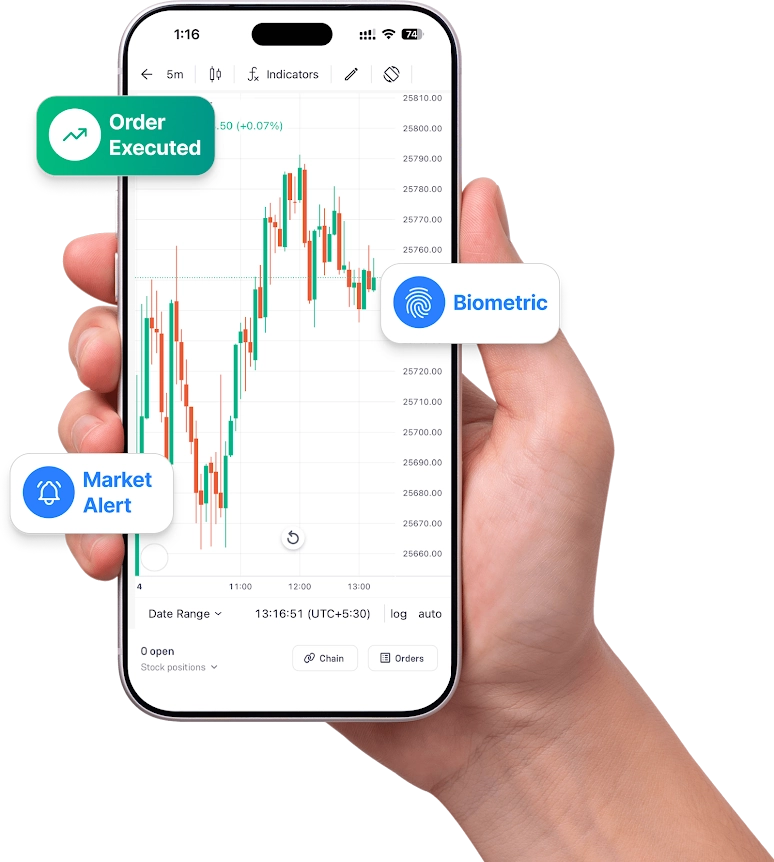
Unified Portfolio
All Assets, One App
Instant Market Alerts
Live Research, Zero Delay
Seamless Security
Biometric Login for Safe Trading
Actionable Ideas
Pre-built Options Strategies
Based on 27.8K reviews
1M+
Downloads