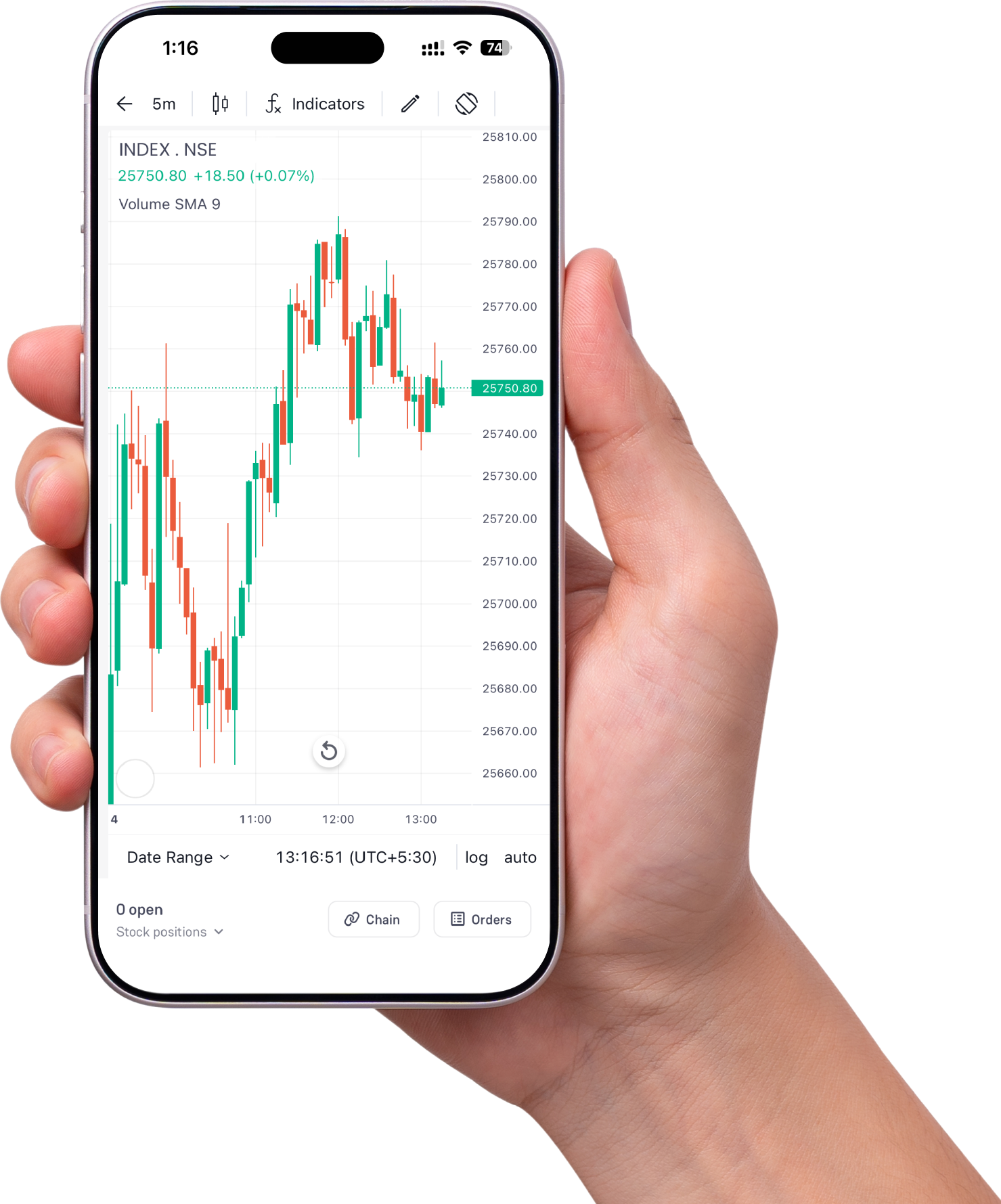
What is Tick Trading in the Stock Market?

Do you know what is tick trading? Tick is a type of trading that involves taking advantage of the smallest possible change in the prices of securities in the stock market, referred to as ticks. The most common form of tick trading is intraday trading, which involves making profits from very small price changes in stocks over a single trading day. Before defining the term ‘tick’ in trading, it is important to understand its meaning.
Tick trading involves making decisions based on very small changes in the prices of stocks. In this respect, a tick is the smallest possible price move of a stock. If, for instance, a stock changes from ₹100.00 to ₹100.05, the ₹0.05 rise represents one tick.
What is Tick in Trading?
In layman’s terms, a tick is an increment in the price of a security. The increments could be upward or downward. In the context where the question “What is a tick in trading?” is raised by traders, a tick is the smallest unit of price movement for a stock.
For example:
If a stock goes from ₹250.00 to ₹250.10, the ₹0.10 is a tick.
- Every market sets its own tick size.
- It is imperative to learn about ticks since tick movements serve as the basis for scalping and tick trading.
What is Tick Size?
The tick size means the minimum amount by which the price of a stock changes.
For instance:
- When the tick size is ₹0.05, the change in stock prices will be from ₹100.00 to ₹100.05, ₹100.10, and so on.
- There will be no movement at ₹100.03, since this figure is not in accordance with the tick size.
- The tick size makes sure there is consistency in stock prices, thus avoiding any unnecessary volatility resulting from the variation in prices.
Understanding Tick Chart Trading
Tick chart trading involves the creation of charts wherein price action is recorded based on a constant number of ticks as opposed to time periods. Unlike other traditional charts like 1-minute or 5-minute charts, tick charts create a new bar only once a certain number of ticks have occurred.
Examples include:
- A 100-tick trading chart generates a new bar when 100 ticks have taken place.
Tick charts are very useful in volatile markets due to the following reasons:
- They reflect actual price movements
- Reduce noise caused by low volumes of trading
- They offer clear entry and exit points
Traders who use a demat account and a trading account frequently use tick charts.
How Tick Trading Works?
Tick trading is based on exploiting very small price changes. The trader initiates and closes positions fast, sometimes in seconds, in order to make tiny profits that are accumulated over several trades.
This is how it normally operates:
- Observation of the Market: The trader observes the market in terms of very liquid stocks, where price changes occur frequently.
- Spotting the Entry Point: Through the use of tick charts and technical indicators, the trader spots micro-trends.
- Immediate Execution: The orders are immediately placed through online stock trading websites.
- Realizing Profits: The trader realises profits by closing positions once a small profit is made.
- Repetition of the Process: Tick trading is often executed in intraday trading, as positions are not carried overnight.
Role of Option Chain in Tick Trading
An option chain for tick trading is very important for traders working with derivatives. Real-time information on prices, strikes, and other factors such as sentiment is provided by option chains.
Tick trading with the aid of option chains allows traders to:
- identify highly liquid strike prices
- Monitor sudden changes in option prices
- Know about demand and supply forces at work in the market.
Tick Trading Strategy
A clearly defined tick trading strategy is very important, as even a tiny blunder can cause losses.
The following are some popular tick trading strategies:
1. Scalping Trading Strategy
The traders make money on a few ticks multiple times a day. High liquidity and low spreads are required for this.
2. Momentum-based Trading
Traders make their trades in stocks with high momentum in either up or down directions and leave the market soon by making profits on just a few ticks.
3. Order Flow
This is a trading technique in which traders analyse order flow for future prices of stocks.
4. Breakout Trading
This strategy involves traders looking for key areas and trading small breakouts.
All these strategies need discipline and proper infrastructure.
Advantages of Tick Trading
There are a few benefits associated with tick trading, particularly for seasoned traders:
Gains Are Made Easily: Small profits can accumulate over multiple trades.
- Not Overdue: Trades do not stay open overnight.
- Market Liquidity: Trading is done on highly liquid stocks.
- Insight into the Market: Tick charts show current trading activities.
Risks Associated with Tick Trading
Despite the few positive aspects related to tick trading, certain risks cannot be overlooked:
- Increased Broking Fee: This may lead to increased broking fees due to high turnover.
- Noisiness of the Market: The small changes may cause false trends.
- Psychological Problems: Rapid decision-making might result in psychological stress.
- Technical: Effective trading requires good internet connectivity.
Tools Required for Tick Trading
For tick trading success, the following tools are usually used by traders:
- High-tech charting software that provides tick charts
- Fast-speed internet
- Real-time market information
- Technical indicators like moving averages and RSI
- Option chain and market depth data
These tools assist traders in making fast and accurate decisions.
Is Tick Trading Suitable for Beginners?
Tick trading is not advisable for novice traders. It requires:
- Sound understanding of the market
- Quick action
- Discipline
Novice traders need to develop an understanding of how the stock market works and gain experience by trading on paper before proceeding to tick trading.
Key Takeaway
Tick trading is a very intensive trading system within the stock market where traders aim at taking advantage of even the slightest price changes. It is only through learning about what a tick is in trading and what tick size is, among others, that tick chart trading and tick option chains can be used to spot profitable chances.
Tick trading needs a great deal of discipline and knowledge of how the markets behave. While profits can be made instantly, tick trading needs adequate measures to be put in place.
Frequently Asked Questions (FAQs)
What is Tick Trading?
Tick trading is a short-term trading strategy where traders try to profit from very small price movements, known as “ticks”, in stocks or other financial instruments. It is commonly used in intraday trading, where traders closely monitor market movements and execute quick buy or sell orders.
Explain how latency influences tick trading success?
Latency plays an important role in tick trading, as even a small delay will influence your trade execution. With faster systems, one will be able to get better price captures; however, slow executions will result in slippage. Those who use advanced trading platforms and low-latency connectivity will have an advantage over others.
Which stocks are the ideal choices for tick trading?
The ideal choice of stocks to trade on a tick level is those that have higher liquidity and a narrow spread between bid and ask, as well as regular price movements. Often, large-cap stocks and derivatives are used, as there are more tick changes possible in these securities.
Explain the influence of broker fees on tick trading success?
High-frequency trading, which includes tick trading, too, requires a lot of executions during the trading process. Thus, brokers’ fees become crucial when it comes to tracking profits, as they can reduce overall earnings. It is important to work with a low-cost broker.
Is it possible to implement algorithmic trading in tick trading?
Algorithmic trading is commonly applied in tick trading. Trading algorithms operate faster than manual traders since they trade based on predetermined conditions. Trading algorithms facilitate the removal of any emotion that may interfere with decision-making.
How significant is the bid-ask spread in tick trading?
The bid-ask spread is important in determining the profits in tick trading. The smaller the bid-ask spread, the easier it becomes to generate profits, while the larger bid-ask spread minimises the gains.