• Products
  • Research
  • Partner with us
  • Blog
  • Refer A Friend
Open Free Demat Account
Trade Now
Open Free Deamt Account
Trade Now
  • Products
  • Research
  • Partner with us
  • Blog
  • Refer A Friend
Home » Blog » Stock Market » Indo-US Trade Deal 2026: How It Will Boost FII Inflows
anil gangwar by anil gangwar
March 16, 2026
in Stock Market
0

Indo-US Trade Deal 2026: How It Will Boost FII Inflows

Indo-US Trade Deal 2026

Indo-US Trade Deal 2026

  • Last Updated: Mar 16,2026 |
  • anil gangwar

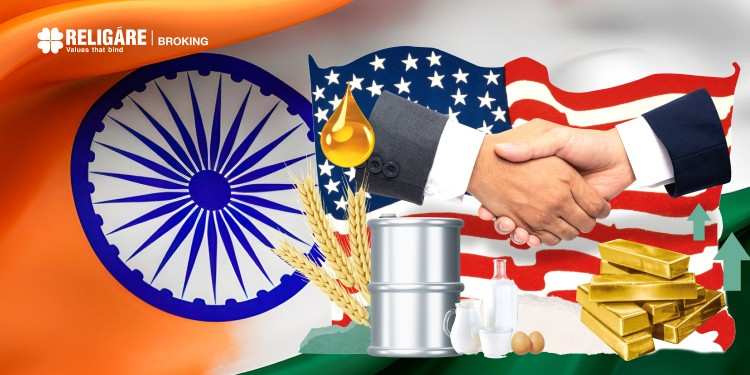
The Indo-US Trade Deal 2026 is anticipated to become a milestone in bilateral economic relations between India and the United States. During the negotiation process, investors are keen on the impact the Indo US trade agreement 2026 is likely to have on the foreign capital flows, especially FII inflows into Indian equity and debt markets. Foreign Institutional Investors (FIIs) normally react well to the macroeconomic stability, transparency of the policies, and in terms of trade expansion structures. The Indo-US Trade Deal 2026 may increase investor confidence and bring long-term capital investment in India if it is implemented efficiently.

What is the Indo-US Trade Deal 2026?

The Indo-US Trade Deal 2026 seeks to improve bilateral trade by lowering tariffs, improving market access, enhancing supply chain integration, and enhancing collaboration across strategic areas of technology, pharmaceuticals, energy, and defence. It is anticipated that the proposed Indo US trade agreement 2026 will:

  • Lower tariffs on some goods
  • Better access for Indian goods to US markets
  • Making supply chain collaboration stronger
  • Enhanced cooperation in clean energy, defense, and technology
  • Safeguarding intellectual property rights

This type of structural reform may greatly contribute to the increased Indian appeal as an emerging market destination.

How the Indo-US Trade Deal Could Accelerate FII Inflows

The relationship between the stock market performance and inflows of FII between the Indo-US trade deal is direct. Trade agreements enhance transparency in the economy and this lessens the perceived risk by international investors. Here is how the Indo-US Trade Deal 2026 could increase the FII participation:

  1. Greater Economic Stability: A stable bilateral trade regime may reduce uncertainty in policies that encourage long-term foreign commitment of capital.
  2. Increased Corporate Earnings Disclosure: One of the advantages of export-oriented industries is the reduction in tariffs, which enhance revenue projections, which is one of the reasons why FII allocation is made.
  3. Stronger Currency Outlook: An influx of trade will help the rupee by providing it with enhanced foreign currency reserves, and this motivation will bring in more institutional investments.
  4. Strategic Alignment: The increased economic relations between the US and India may strengthen geopolitical confidence, which is a major concern among the foreign investors.

Trade normalisation deals in the past have been accompanied by increasing equity inflows and the Indo-US Trade Deal 2026 will potentially follow the same pattern.

Indo-US Trade Deal Sectors Likely to Benefit

The sectors within the India US trade deal that may experience a great momentum are:

  • Information Technology: The reduction of trade barriers and increased digital cooperation could boost exports of IT.
  • Pharmaceuticals: The regulatory alignment could ease entry into the US healthcare markets.
  • Manufacturing & Electronics: India may become a more favourable manufacturing hub as global supply chains diversify away from heavy dependence on China.
  • Renewable Energy: Combined efforts to invest in clean energy projects could open new sources of capital.
  • Defence & Aerospace: The high-value exports can be expanded through strategic cooperation.

FIIs are keen on these sectors under a potential India-US trade deal in the quest to find scalable growth opportunities.

India US Trade Deal Winners and Losers

Any trade agreement will have both opportunities and competitive pressures. It is crucial to study the losers and winners of the India-US trade deal and allocate investments across sectors accordingly.

Potential Winners:

Export-driven industries

  • The manufacturers of capital goods.
  • Shipment companies and logistics.
  • Service providers in technology services.

Potential Losers:

  • Industries in the country are exposed to US competition.
  • Industries that are not very competitive in export.
  • Firms that are reliant on protection tariffs.

Learning about the winners and losers in the India-US trade deal will help investors to rebalance their portfolios strategically.

Impact on Equity Markets and Capital Flows

Indo-US Trade Deal 2026 could strengthen India’s position as a leading emerging market investment destination for global investors. FIIs prioritise:

  • Policy consistency
  • Trade openness
  • Earnings growth potential
  • Currency stability

If the Indo-US trade agreement 2026 yields positive gains in these areas, then India might enjoy equity inflow, especially with large-cap export-oriented firms. Another effect of higher FII inflows following the Indo-US trade deal could be greater liquidity in the markets, lower volatility and even stronger performance of benchmark indices like the Nifty 50 and Sensex.

Key Takeaway

The impact of the Indo-US Trade Deal 2026 on the capital markets of India could be substantial since it may boost investor confidence and spur FII inflows in the Indo-US trade deal. As different sectors of India’s US trade deal are poised for growth and with better insights into the winners and losers,, institutional investors may increase their investments in Indian equities. The Indo US trade agreement 2026, once successfully implemented, has the potential to be a structural kick-starter of foreign investment and economic growth in the long run.

Quick Links

Invest in US Share Market US Stock Market Timings What is US Stock Market
Difference Between Indian and US Stock Markets

Frequently Asked Questions (FAQs)

Is the impact of the Indo-US trade deal on FII inflows short-term or long-term?

While markets may give a positive response in the short-term, the long-term effects will be based on practical implementation, growth in the volume of trade and structural economic enhancement.

How does currency stability affect FII inflows under the Indo-US trade deal?

Closer trade relations can make the exchange reserves stronger and even help to maintain the stability of the rupee. The fixed currency lowers the exchange-rate risk of the foreign investors, thereby promoting long term capital inflows.

Can the Indo-US trade deal shift global FII allocation toward India over other emerging markets?

Yes, provided the agreement enhances competitiveness in trade and policy transparency, India might receive more allocations than other emerging markets, which have poor trade structures.

How could the Indo-US trade deal influence FII investment in Indian mid-cap stocks?

In addition to exporters in large capitals, better trade opportunities can make FII more exposed to the high growth mid-cap firms associated with manufacturing, logistics and supply chain development.

Could the Indo-US trade deal increase FII participation in India’s debt market?

Yes, with closer economic engagement potentially drawing FII investments to government and corporate debt, especially if currency stability is achieved.


Tags: Indo-US Trade DealIndo-US Trade Deal 2026Indo-US trade agreement 2026Indo-US trade agreement

Navigate Stock Market Trends & Invest with Precision

Open Stock Trading Account
anil gangwar

anil gangwar

Anil Gangwar is a content marketing professional specializing in SEO-optimized, user-friendly financial content. He focuses on simplifying complex financial concepts and delivering clear, actionable insights that help readers make informed decisions.

Related Posts

Indo-US Trade Deal 2026
Stock Market

The India-US Trade Deal Decoded: Sector Winners, Losers

Mar 16,2026

NRI Trading Account in India
Stock Market

Everything You Need to Know about NRI Trading Account in India

Jan 30,2026

Guide to Fundamental Analysis of Stocks for Retail Investors in India
Stock Market

Step-by-Step Guide to Fundamental Analysis of Stocks for Retail Investors in India

Jan 27,2026

What is Margin Shortfall in MTF
Stock Market

What is Margin Shortfall in MTF?

Sep 09,2025

What is Compounding Strategy
Stock Market

Compounding: The Most Powerful Strategy in Investing

Sep 09,2025

Algo Trading Strategy without Coding
Stock Market

Capital Gains Tax and How It Affects Investment Strategy

Sep 09,2025

Disclaimer:This blog is written exclusively for educational purpose. Any stock mentions in the blog are examples and not recommendations. Please refer to our research reports or analyst recommendations for stock ideas.

No Result
View All Result

Open a Free Demat & Trading Account

Please enter valid name
Please enter valid phone

Category

  • Algo Trading (7)
  • ETFs (2)
  • Insurance (9)
  • Investment (3)
  • Income Tax (2)
  • Commodity Trading (18)
  • Saving Schemes (12)
  • Derivatives Trading (86)
  • Currency Trading (4)
  • TradingView (2)
  • Margin Trading (7)
  • National Pension Scheme (2)
  • Stock Market (188)
  • Online Share Trading (104)
  • Demat Account (38)
  • Mutual Funds (79)
  • IPO (28)
  • Indian Market & Economy (9)
  • Tax (15)

Popular Blogs

Options Expiry and Settlement
What are the Major Types of Trade in the Indian Stock Market?
What is Debt to Equity Ratio
Debt-to-Equity Ratio: A Comprehensive Guide
What is Relative Strength Index
What is Relative Strength Index (RSI)?
What are Shares
What Are Shares?
Algo Trading Strategy without Coding
Understanding the Concept of NISM Certifications

Latest Blogs

Indo-US Trade Deal 2026
The India-US Trade Deal Decoded: Sector Winners, Losers
Indo-US Trade Deal 2026
Indo-US Trade Deal 2026: How It Will Boost FII Inflows
Difference Between Active and Passive Mutual Funds
Difference between Active and Passive Mutual Funds​
Corporate Bonds vs Government Bonds in India: Key Differences Explained
Corporate vs Government Bonds Explained for Indian Portfolios
How AI and Algo Trading Will Change Stock Broking in India
How to Invest in Silver ETFs in India?
Term Insurance vs Endowment Plans
Term Insurance vs Endowment Plans: Which Life Insurance Plan Should You Choose
Silver ETF vs Physical Silver
Silver ETF vs Physical Silver: Which is Better for Indian Investors?
Motor Insurance in India
Motor Insurance in India: Comprehensive vs Third-Party Cover Explained
Individual vs Family Floater Health Insurance
Individual vs Family Floater Health Insurance: Which One Should You Choose?
Learn More About Stock Market


Markets

  • Upcoming IPO
  • Buyback Shares
  • Listed IPO
  • IPO Subscription Status

Products

  • Overview
  • Equity
  • Derivatives
  • Commodities
  • Currency
  • Margin Trading Facility
  • IPO
  • SME IPO
  • Mainboard IPO

Services

  • NPS
  • Open Demat Account
  • Open Trading Account
  • Open NRI Account

Research

  • Investment Ideas
  • Trading Calls
  • Research Reports
  • Blog
  • Glossary
  • Knowledge Centre
  • Stock Market Holidays
  • NSE Holidays
  • BSE Holidays

Support

  • FAQ
  • Contact Us
  • Locate Us
  • Downloads
  • Calculators
  • Margin Calculator
  • Margin Matrix
  • Demat Account FAQs
  • Trading Account FAQs
  • Freezing / Unfreezing of Online trading Access
  • About Us
  • Notification
  • Disclaimer
  • Privacy Policy
  • Terms Conditions
  • Rules Regulations
  • Corporate Information
  • Educational Note For Clients On PMLA
  • Partner with Us
Important Links
  • NSE
  • BSE
  • SEBI
  • MCX
  • NCDEX
  • MSEI
  • NSEL
  • IRRA
Investor Complaints
  • NSE
  • BSE
  • MCX
  • SEBI
  • SEBI SCORES
  • NCDEX
  • MSEI
  • SMARTODR
E-Voting Facility
  • NSDL
  • CDSL
Upcoming IPO
  • Kumar Arch Tech IPO
  • Kalpataru Ltd IPO
  • Onset Ltd IPO
  • Manjushree Technopack IPO
  • instagram
  • instagram
  • instagram
  • instagram
  • instagram
  • instagram
  • instagram

Unified Portal Version No.1.0.0.2

Copyright 2010 Religare. Trademarks are the property of their respective owners. All rights reserved. Religare Broking Limited (CIN: U65999DL2016PLC314319), Registered Office: 802 -815B, 8th Floor, Gopal Das Bhawan, 28-Barakhamba Road, Connaught Place, New Delhi - 110001.
Telephone No.: +91-011-49871213 | Fax: +91-011-49871189
E-mail: wecare@religareonline.com

Member Religare Broking Limited (RBL) : SEBI Regn. No. INZ000330135 NSE CM, F&O, CD TM Code: 06537 Clearing Member (F&O) No. M50235; BSE CM, F&O, CD, CO Code: 3004 Clearing No: 3004; MSEI CM, F&O, CD, TM Code: 1051 | MCX Membership No. 56560 | NCDEX Membership No. 01276 | AMFI-registered Mutual Fund Distributor ARN No.139809.

Member Religare Commodities Limited (RCL) : Regn No. MCX 10575 | NCDEX 00109|NeML 10042|NSEL 10180 |SEBI Registration No. MCX/NCDEX :INZ000022334.

Depository Participant : Religare Broking Limited (RBL) - NSDL: DP ID: IN 301774 | SEBI Regn. No: IN-DP-385-2018 | CDSL DP ID: 30200 | SEBI Regn. No: IN-DP-385-2018

Religare Broking Limited(RBL) : Research Analyst SEBI Regi. No : INH100006977 | BSE Ltd. (RAASB) Enlistment No. 5334

Religare Broking Limited(RBL) : Registrars to an issue and share Transfer Agents (RTA) - SEBI Regi. No : INR000004361

Religare Broking Limited(RBL) : Corporate Agent (Composite) - IRDA Regi. No : CA0581

Religare Broking Limited(RBL) : National Pension System - Point of Presence (NPS-POP) - PFRDA Regi. No : POP01092018

Advisory for Investors

  • Investor Charter Stock Broker
  • Investor Charter Research Analyst
  • Investor Charter of Depository Participant
  • Advisory KYC Compliance
  • Investor Charter of Registrars to an issue and share Transfer Agents (RTA)
  • How to process fund transfer via UPI
  • For Reporting of Cyber attack/incident Click here..!!
  • Details of Client Bank Accounts of Religare Broking Limited
  • How to Link Your Aadhaar Number with Demat Account
  • How to link Aadhaar Card with your PAN Card
  • How to Open a Demat & Trading Account Online
  • Member Details
  • SOP - Centralized mechanism for reporting the demise of an investor through KRAs
  • SEBI Investor Website
  • SOP for Incapacitated investor
  • SEBI Circular - Opening of Demat Account in the name of Association of Persons
SEBI-Investor-Certification-Examination.

ATTENTION INVESTOR

-- Stock Brokers can accept securities as margin from clients only by way of pledge in the depository system w.e.f. September 1, 2020.

-- Update your mobile number & email Id with your stock broker/depository participant and receive OTP directly from depository on your email id and/or mobile number to create pledge.

-- 20% upfront margin of the transaction value to trade in cash market segment.

-- Investors may please refer to the Exchange's Frequently Asked Questions (FAQs) issued vide circular reference NSE/INSP/45191 dated July 31, 2020 and NSE/INSP/45534 dated August 31, 2020 and other guidelines issued from time to time in this regard.

-- Check your Securities /MF/ Bonds in the consolidated account statement issued by NSDL/CDSL every month.

-- Prevent unauthorized transactions in your account - Update your mobile numbers/email IDs with your stock brokers. Receive information of your transactions directly from Exchange on your mobile/email at the end of the day - Issued in the interest of Investors.

-- Prevent Unauthorized Transactions in your demat account Update your Mobile Number with your Depository Participant. Receive alerts on your Registered Mobile for all debit and other important transactions in your demat account directly from Depository (NSDL/CDSL) on the same day issued in the interest of investors.

--If you have any grievance you may reach Religare Broking Limited at igreligare@religare.com & Religare Commodities Limited at ig.commodities@religare.com.
If the complaint does not get redressed within 21 days, the complainant may use SCORES to submit the grievance.

--Filing complaint on SEBI SCORES – Easy & quick
a. Register on SCORES portal.
b. Mandatory details for filing complaints on SCORES - Name, PAN, Address, Mobile Number, E-mail ID.
c. Benefits - Effective Communication & speedy redressal of the grievances

-- No need to issue cheques by investors while subscribing to IPO. Just write the bank account number and sign in the application form to authorise your bank to make payment in case of allotment. No worries for refund as the money remains in investors account.

-- KYC is one time exercise while dealing in securities markets - once KYC is done through a SEBI registered intermediary (broker, DP, Mutual Fund etc.), you need not undergo the same process again when you approach another intermediary.

-- Trading and Demat Accounts opened under Insta Plan will not be eligible for dealing through branches.

-- Please note that by submitting your mobile and email on our website, you are authorizing us to Call/SMS/Whtsapp/RCS/Email you even though you may be registered under DNC. We shall Call/SMS you for a period of 12 months.

Religare Broking Limited do not have any arrangement either with Times Internet or with Refinitiv for Research Portfolio Report sharing

Saarthi-Flyer

No Result
View All Result
  • Products
  • Research
  • Partner with us
  • Blog

© 2021 RELIGARE -Designed By Religare.

Open Demat Account
Please enter valid name
Please enter valid phone

Open a FREE Demat
& Trading Account

Invest in Stocks, IPOs, F&O &
Mutual Funds

Please enter valid name
Please enter valid phone
religare logo

Get better recommendations, Make better investments.

Daily Stock Suggestions from Leading Experts!

By signing up, you agree to receive updates on SMS, Email & WhatsApp

Open Demat Account
Open a Free Demat Account

Please enter valid name
Please enter valid phone