How to Trade Options and Futures in India- Risks, Rewards & Strategies?
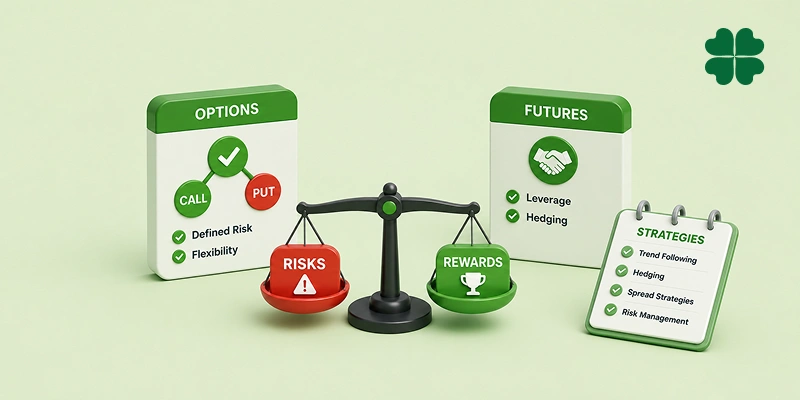
Futures and Options (F&O) trading requires knowledge and skills. You must have a clear knowledge of How to Trade Options and Futures in India. F&Os basics like fundamental analysis, technical analysis, future & option trading strategies and the various put and call options. This form of trading is a bit complex compared to equity investments and therefore it is very important to understand the specifics of this trading prior to initiating trading. The derivatives market is a separate segment of the equity market that trades in Future & Options contracts. If you are new to this and would like to know how futures and options trading in India works, then this guide will help you to know what to do before starting your F & O journey.
What are F&Os?
F&Os are financial agreements that enable you to trade the worth of an asset (such as stocks, indices, gold, etc.) without having to actually buy the asset. Futures: A futures contract refers to the agreement to sell or buy an asset at a fixed price on a given date in future. The buyer and the seller must both settle the contract upon expiry. Options: Options give you the right and not the compulsion to buy or sell an asset. You can also choose not to carry out the trade if it is not profitable. Trading of Options & Futures in India is mostly done on exchanges such as the NSE and BSE under the jurisdiction of the Securities and Exchange Board of India (SEBI).
How to Learn Future and Options Trading?
The most significant aspect of F&O is learning how to properly invest real money before taking the risk.
Read and Study Regularly – Start with basic learning:
- Stock market trading books.
- Online finance courses
- Educational blogs and articles.
You may also take part in learning through the exchange websites such as the National Stock Exchange (NSE) that offer free novice learning content.
Practice With Demo Accounts – Numerous brokers offer virtual trading platforms Benefits:
- No real money risk
- Learn order placement
- Understand market movement
Follow Market News Daily – F&Os markets are responsive to such news as:
- Economic policies
- Interest rate changes
- Global market trends
- Company results
Go Easy at the beginning and acquire experience – Beginners are usually in a hurry to make a profit thus losing in the process. Better approach:
- Start with small trades
- Focus on learning first
- Avoid emotional decisions.
Difference Between Futures and Options – The difference between Future & Option trading is given below:
| Basis | Futures | Options |
| Obligation | You must buy or sell the asset at expiry. | You have the choice to buy or sell, not compulsory. |
| Risk Level | Usually higher risk because losses can increase quickly. | Limited risk for buyers (only premium loss). |
| Cost | Margin money is required to trade. | You only pay a premium to buy options. |
| Flexibility | Less flexible due to compulsory settlement. | More flexible because you can choose not to exercise. |
Step by Step Guide to Trade in Futures & Options in India
The following are the key points to note when trading in futures and options in India:
Open a Trading account
To start with, you must open an account with a broker registered at the National Stock Exchange (NSE) or the Bombay Stock Exchange (BSE) in India where Futures and Options (F&O) contracts exist.
Log in to the Platform
After activating the account, go to the site or the mobile application of your broker and see what types of futures and options contracts are available.
Do proper Research
Examine the market trends, expiry dates, lot sizes and volatility. Decide whether futures or options suit your trading goals and risk profile.
Choose your Contract
Choose the asset and strike price carefully. Strike price is the price at which a call option allows you to purchase, and a put option allows you to sell an underlying asset.
Place your Order
When you expect the price to rise, the traders will usually purchase call options or sell put options. On the other hand, when you are sure that prices are going down, you would purchase put options or sell call options.
Know the Potential Consequences
You may sell the contract before it lapses at a profit or loss, exercise it when circumstances are favorable or leave it to expire worthless when circumstances are unfavourable.
Risks and Benefits of Futures & Options Trading
To trade in Futures & Options, any new investor must refer to the risks and benefits before making any investment. The possible risks and benefits are given below:
| Aspect | Risks | Benefits |
| Profit Potential | Losses can increase quickly due to leverage. | Possibility of higher profits with smaller capital. |
| Market Volatility | Sudden market changes can cause big losses. | Volatility can create good trading opportunities. |
| Capital Requirement | Margin calls may require extra funds. | Lower upfront investment compared to fully buying stocks. |
| Complexity | Requires strong knowledge and experience. | Multiple strategies allow flexibility in trading. |
| Time Factor | Options lose value as expiry approaches. | Short-term trading opportunities available. |
| Risk Management | Poor planning can lead to heavy losses. | Useful for hedging and protecting investments. |
Simple Strategies for Beginners in Futures & Options
Simple and low-risk strategies should be considered as the first steps in case you are a novice to futures and options trading. Such strategies assist you in knowing the behaviour of the market without taking any risks.
Hedging Strategy
Hedging is securing your current investment against any loss through taking a counter position in F&Os.
How it works:
- Consider that you are a shareholder of a firm.
- You can purchase a put option or sell futures in case you believe that the prices will go down.
- In case of a loss in the price, the share loss can be offset by profit in F&O.
Trend Following Strategy
This is among the simplest starting strategies. The concept is simple: do not guess, follow the market trend.
How it works:
- Uptrend (market increasing): Buy call options or futures.
- Down trend (market declining): Sell futures or buy put options.
Covered Call Strategy
This plan is applicable in case you already have stocks.
How it works:
- Hold shares of a company.
- Sell a call option on said shares.
- You get high-end earnings when the stock price remains intact.
Spread Strategy
A spread strategy deals with the acquisition and disposal of options in order to minimise risk.
Example:
- Buy one call option.
- Sell another higher-priced call option.
Risk Management in Future & Options Trading
In F&Os trading, risk management is crucial to reduce the possible losses. Key strategies include:
- Position sizing: Restricting the amount of capital risked on a single trade.
- Stop-loss orders: Automatic exits set to limit losses.
- Diversification: Spreading of investments across different assets in an effort to minimise risk.
- Hedging: Hedging is the use of derivatives to cover possible losses in other investments.
- Leverage control: Leverage should be used carefully to prevent an increase in risks.
These steps help ensure long-term financial stability by providing a buffer against market volatility.
Conclusion
As mentioned earlier, futures and options are associated with a high degree of risk because accurate projections of price movements are essential. Successful trading in derivatives requires good knowledge of the stock market, the underlying assets and the companies behind them to generate profits.
Frequently Asked Questions (FAQs)
What is the difference between futures and options trading?
Futures contracts obligate traders to buy or sell an asset at a fixed price on a future date, while options provide the right, but not the obligation, to buy or sell the asset.
What are the main risks involved in options and futures trading?
The key risks include market volatility, leverage-related losses, margin calls, and rapid price fluctuations that can result in significant losses.
Which strategies are commonly used in options trading?
Popular options trading strategies include covered calls, straddles, strangles, iron condors, and bull or bear spreads, depending on market outlook and risk tolerance.