Old Tax Regime vs New Tax Regime FY 2026-27: Which Should you Choose?
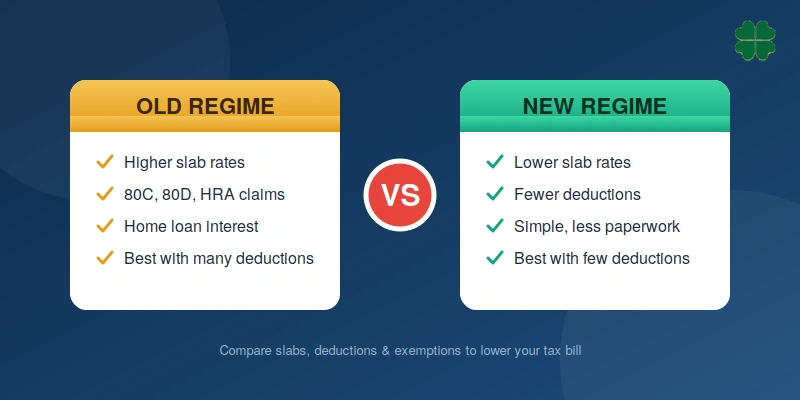
Choosing between the Old Tax Regime vs New Tax Regime for AY 2026-27 depends on your taxable income, eligible deductions and exemptions, and the type of income you earn. The new tax regime is the default regime, but eligible taxpayers can opt for the old tax regime. This guide explains the applicable tax slabs, key differences, an illustrative calculation, and important deductions to consider before selecting a regime.
Old Tax Regime
The old tax regime allows eligible taxpayers to claim a wider range of deductions and exemptions, subject to the conditions prescribed under the Income-tax Act. These can include deductions under Section 80C and Section 80D, eligible home-loan interest under Section 24(b), and HRA exemption where the applicable conditions are met.
Some commonly used provisions under the old tax regime include:
- Section 80C: eligible investments and payments, subject to the combined deduction limit of ₹1.5 lakh.
- Section 80D: eligible health-insurance and specified medical-expense deductions, subject to applicable limits and conditions.
- Section 24(b): eligible deduction for interest on a housing loan, subject to the applicable conditions and limits.
- HRA exemption: available to eligible salaried taxpayers under the prescribed conditions.
For individuals below 60 years of age, the basic old-regime slab structure for AY 2026-27 is shown below. Senior and super-senior citizens have different basic exemption limits under the old regime.
| Income Slab | Tax Rate |
| Up to ₹2.5 lakh | Nil |
| ₹2.5 lakh to ₹5 lakh | 5% |
| ₹5 lakh to ₹10 lakh | 20% |
| Above ₹10 lakh | 30% |
New Tax Regime
The new tax regime, introduced in Budget 2020 and subsequently amended, is the default tax regime for eligible taxpayers. It provides wider income slabs and lower rates at several income levels, but permits fewer deductions and exemptions than the old regime.
For AY 2026-27, the new-regime slab rates are:
| Income Slab | Tax Rate |
| Up to ₹4 lakh | Nil |
| ₹4 lakh to ₹8 lakh | 5% |
| ₹8 lakh to ₹12 lakh | 10% |
| ₹12 lakh to ₹16 lakh | 15% |
| ₹16 lakh to ₹20 lakh | 20% |
| ₹20 lakh to ₹24 lakh | 25% |
| Above ₹24 lakh | 30% |
For eligible resident individuals, Section 87A provides a rebate of up to ₹60,000 under the new regime where taxable income does not exceed ₹12 lakh, subject to the applicable conditions. The rebate can reduce the tax payable to nil where the calculated tax is within the rebate limit.
Old Tax Regime vs New Tax Regime: Key Differences
| Point of Difference | New Tax Regime | Old Tax Regime |
| Default regime | Default regime for eligible taxpayers. | Eligible taxpayers can opt out of the default regime and choose the old regime. |
| Tax slabs | More income slabs, with rates from Nil to 30% for AY 2026-27. | Fewer slabs, with rates from Nil to 30% for individuals below 60. |
| Standard deduction | ₹75,000 for eligible salaried individuals and pensioners. | ₹50,000 for eligible salaried individuals and pensioners. |
| Deductions & exemptions | Fewer deductions and exemptions are available, subject to specified conditions. | A wider range of deductions and exemptions can be claimed, subject to eligibility. |
| HRA exemption | Generally not available under the new regime. | Available subject to prescribed conditions. |
| Tax-saving investments | Most common investment-linked deductions such as Section 80C are not available. | Eligible deductions such as Section 80C can be claimed subject to the applicable rules. |
| NPS | Employer contribution under Section 80CCD(2) can be claimed subject to applicable limits. | Eligible NPS deductions can be claimed subject to the applicable provisions. |
| Calculation | Generally involves fewer deductions and exemptions. | May require calculation of multiple eligible deductions and exemptions. |
Old Tax Regime vs New Tax Regime: Example Calculation
Consider a salaried resident individual below 60 years of age with gross salary income of ₹12 lakh. For illustration, assume the individual is eligible for ₹50,000 standard deduction, ₹1.5 lakh under Section 80C, ₹50,000 eligible HRA exemption, and ₹50,000 under Section 80D under the old regime. Under the new regime, assume only the ₹75,000 standard deduction is available. The calculation below assumes normal slab-rate income and eligibility for the Section 87A rebate.
| Particulars | Old Tax Regime | New Tax Regime |
| Gross salary income | ₹12,00,000 | ₹12,00,000 |
| Standard deduction | ₹50,000 | ₹75,000 |
| Section 80C | ₹1,50,000 | Not available |
| HRA exemption | ₹50,000 | Not available |
| Section 80D | ₹50,000 | Not available |
| Taxable income | ₹9,00,000 | ₹11,25,000 |
Tax calculation
| Calculation | Old Tax Regime | New Tax Regime |
| Tax on first slab | Nil | Nil on first ₹4 lakh |
| Tax on next slab | ₹12,500 on ₹2.5 lakh | ₹20,000 on ₹4 lakh |
| Tax on remaining taxable income | ₹80,000 on ₹4 lakh | ₹32,500 on ₹3.25 lakh |
| Tax before rebate/cess | ₹92,500 | ₹52,500 |
| Section 87A rebate | Not applicable at this taxable income | ₹52,500 rebate, subject to eligibility |
| Tax after rebate | ₹92,500 | Nil |
| Health & Education Cess | ₹3,700 | Nil |
| Illustrative tax payable | ₹96,200 | Nil |
This is an illustrative comparison, not a personalised tax computation. Actual tax liability can change based on the taxpayer’s age, residential status, income composition, eligible deductions/exemptions, special-rate income, and other applicable provisions.
Which Tax Regime Should You Choose?
There is no single regime that is suitable for every taxpayer. Compare the tax liability under both regimes after considering the deductions and exemptions for which you are actually eligible.
- The new regime may be relevant for taxpayers who have relatively few eligible deductions and prefer a tax structure with fewer deductions and exemptions.
- The old regime may be relevant for taxpayers who can claim substantial eligible deductions and exemptions, such as Section 80C, Section 80D, eligible HRA exemption and eligible home-loan interest.
- Taxpayers should compare their final tax liability under both regimes rather than deciding solely on the basis of gross salary.
- Eligible resident individuals should also consider the Section 87A rebate when comparing tax liability under the new regime.
How to Choose Between Old and New Tax Regime?
Start by calculating taxable income under each regime. List only the deductions and exemptions for which you meet the applicable conditions. Then calculate the tax, applicable rebate, surcharge and cess under each regime. The Income Tax Department also provides an income-tax calculator that can be used to compare tax liability.
Read Also: Income tax implications on Demat Account?
Default Regime and Switching Between Regimes
The new tax regime is the default regime for eligible taxpayers. Taxpayers without business or professional income can generally opt out of the new regime and choose the old regime directly in the ITR, subject to the applicable due date under Section 139(1).
Eligible taxpayers having income from business or profession who want to opt out of the new regime generally need to furnish Form 10-IEA within the prescribed time. The rules governing re-entry into the new regime are subject to the conditions applicable to such taxpayers.
Open your Demat account Today!
Conclusion
The old and new tax regimes differ mainly in their slab structure and the deductions and exemptions available to taxpayers. The new regime is the default regime for AY 2026-27 and provides wider slabs with fewer deductions, while the old regime allows a wider range of deductions and exemptions subject to eligibility.
Before choosing a regime, compare your actual taxable income and eligible deductions under both options. A taxpayer’s appropriate choice can depend on individual circumstances, so the calculation should be based on the taxpayer’s own income and eligible claims.
Additional Read: How Equity Shares are Taxed?
Frequently Asked Questions (FAQs)
What are the Old Tax Regime and New Tax Regime?
The old tax regime provides higher slab rates with a wider range of deductions and exemptions, subject to eligibility. The new tax regime is the default regime for eligible taxpayers and provides wider income slabs with fewer deductions and exemptions.
Why was the New Tax Regime introduced?
The new tax regime was introduced to provide a simplified tax structure with wider income slabs and lower rates at several income levels, while reducing the number of deductions and exemptions available under the tax system.
Will the Old Tax Regime be Discontinued?
The Income Tax Department currently provides for both regimes. The new regime is the default, while eligible taxpayers can opt for the old regime subject to the applicable rules and conditions.
Which deductions are allowed in the New Tax Regime?
The new regime permits certain specified deductions and exemptions. For eligible salaried individuals and pensioners, a standard deduction of ₹75,000 is available. Employer contributions to NPS under Section 80CCD(2) are also allowed subject to applicable conditions and limits.
Which deductions are not allowed in the New Tax Regime?
Most commonly claimed deductions such as Section 80C, Section 80D, Section 80TTA, and Section 80TTB are not available under the new regime. HRA exemption is also generally not available. Specific provisions that remain available should be checked against the applicable rules.
What is the difference between the Old Tax Regime and New Tax Regime?
The main differences are the slab structure and the deductions and exemptions available. The new regime has wider slabs and fewer deductions, while the old regime has fewer slabs and allows a wider range of deductions and exemptions subject to eligibility.
Is Section 80TTA applicable in the New Tax Regime?
No. Section 80TTA deduction is not available under the new regime. Eligible taxpayers choosing the old regime can claim the deduction subject to the applicable conditions and limit.
Is Section 80TTB applicable in the New Tax Regime?
No. Section 80TTB deduction is not available under the new regime. Eligible resident senior citizens choosing the old regime can claim the deduction subject to the applicable conditions and limit.
Is HRA allowed in the New Tax Regime?
The HRA exemption available under the old regime is generally not available under the new regime. Therefore, eligible taxpayers should consider the applicable HRA treatment when comparing both regimes.
Is NPS deduction available in the New Tax Regime?
Employer contributions to NPS under Section 80CCD(2) are allowed under the new regime, subject to the applicable limits and conditions. Other NPS-related deductions may have different treatment depending on the provision.
Which Tax Regime is better?
The appropriate regime depends on the taxpayer’s income, eligible deductions and exemptions, and other applicable provisions. The Income Tax Department recommends comparing the tax liability under both regimes before choosing an option.
Can I switch from the New Tax Regime to the Old Tax Regime?
Taxpayers without business or professional income can generally choose the old regime each year while filing the ITR, subject to the applicable due date. Taxpayers with business or professional income are subject to additional conditions and Form 10-IEA requirements.
Can I file a belated return under the Old Tax Regime?
The option to choose the old regime is subject to the applicable rules and the due date under Section 139(1). Taxpayers with business or professional income must also comply with the prescribed Form 10-IEA requirements. Taxpayers should check the current filing rules before submitting a return.
Disclaimer: The information provided in this article is for general informational and educational purposes only and should not be considered tax, legal, or financial advice. Tax laws, rules, rates, deductions, and exemptions may change from time to time through Finance Acts, notifications, circulars, or other regulatory updates.
Readers are advised to refer to the latest guidelines issued by the Income Tax Department or consult a qualified tax professional before making tax-related decisions. Religare Broking Limited does not guarantee the completeness or accuracy of the information and shall not be responsible for any loss arising from reliance on this content.