Slippage and Latency in Algo Trading: The Hidden Profit Killers for Traders
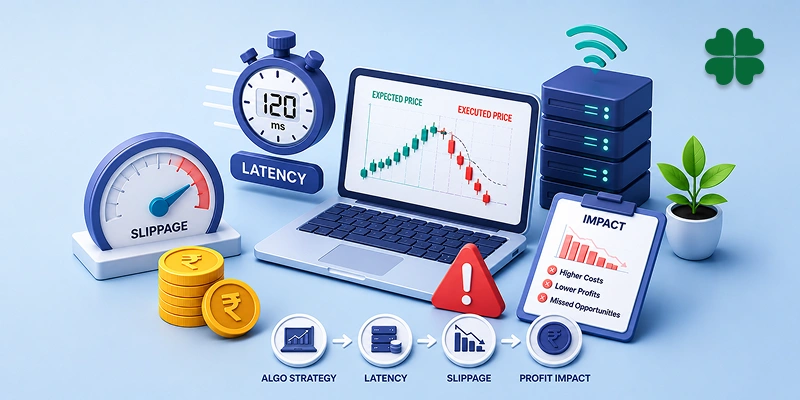
In the rapid-paced field of Algo Trading, time is money. While the strategy may appear as a lucrative option when tested in the past, it can quickly fail in actual trading conditions due to two unseen elements: slippage and latency in Algo trading.
Many traders only pay attention to indicators, entry signs and auto trading. However, seasoned traders know that the hard part is over once the trade is made. A few seconds of waiting or a minor mismatch in execution price could slowly diminish profits without anyone knowing.
Slippage and latency in Algo Trading have become a must-know for every type of trader, especially scalpers and institutions. This is one of the most crucial components to the success or failure of an algorithm in the real market. The guide describes how slippage & latency affect the profit, what causes it, and how traders can minimise its effect while developing more efficient algorithmic trading systems.
Slippage in Algo Trading
Slippage is the gap between the price a trader expects to see when executing a trade and the price at which they actually execute the trade.
For Example:
Your algorithm places a buy order for a stock at ₹1,000
Once the order reaches the exchange, the stock price changes to ₹1,002.
The difference of ₹2 is known as slippage.
During periods of high market volatility, even minor price fluctuations can have a significant effect on profitability, particularly for intraday or high-frequency trading strategies.
Also Read: How to Use Algo Trading for Smarter and Faster Trades
Positive & Negative Slippage in Trading
1. Positive Slippage
The trade is made at a more favourable price than anticipated.
Example:
Expected Buy Price: ₹1,000
Actual Execution: ₹998
This improves profitability.
2. Negative Slippage
The trading doesn’t happen at the desired price.
Example:
Expected Buy Price: ₹1,000
Actual Execution: ₹1,003
This reduces profit numbers and tends to occur when the markets are volatile.
What is Latency in Algo Trading?
Latency is the time lag between:
- Information about the market which is available to the trading system.
- The algorithm used to process the information.
- The order will be transmitted to the exchange.
- Final execution confirmation.
In simple words, latency measures how quickly an algorithm responds to market movements. In the modern world of Algo Trading, latency is measured in :
- Milliseconds (MS)
- Microseconds
- Nanoseconds
The lower the latency, the quicker the execution.
Additional Read: How AI and Algo Trading Will Change Stock Broking in India?
How Slippage and Latency Affect Trading Profitability
Many traders undervalue the importance of execution quality. While a strategy might have impressive backtest results, if the trading speed is slow and slippage is high, real profits could be significantly reduced.
Example:
Assume an algorithm generates:
100 trades per day
Average profit: ₹10 per trade
Expected Daily Profit: ₹1000
Now assume:
Average slippage per trade: ₹2.00
Actual Profit: ₹800
That means 20% of the profit vanished due to execution inefficiency. The effect may be even more serious for high-frequency traders.
How High Latency Can Impact Trading Results?
1. Missed Trading Opportunities
Markets move rapidly. An order that arrives late may come in after the optimum price has been missed.
This is especially dangerous for:
- Scalping strategies
- Momentum trading
- Arbitrage systems
The length of time can make all the difference in trade.
2. Bad entry/exit points are another cause of poor returns
High latency can lead to poor execution of orders.
This results in:
- Lower gains
- Bigger losses
- Reduced risk-reward ratio
These small inefficiencies add up over hundreds of trades.
3. Increased Market Impact
Large orders that are filled slowly can cause the market price to work against the trader.
Advanced execution algorithms can help institutional traders minimise this impact.
4. Strategy Breakdown During Volatility
In times of major market events such as:
- Budget announcements
- RBI policy decisions
- Global economic news
- Earnings releases
There are significant increases in latency and slippage. What works during normal market conditions may become ineffective during highly volatile periods.
Common Causes of Slippage in Algo Trading
The main causes of slippage in Algo trading are explained here:
1. Market Volatility
One of the main causes of slippage is the market volatility. If prices fluctuate quickly, orders could be executed at different prices. In addition to larger spreads, markets that are unstable also lead to faster price changes.
2. Low Liquidity
If the number of trades at a specific price is low, then there could not be enough buyers or sellers at the target price. This can result in less favorable prices being offered in the order book.
3. Large Order Sizes
Very large orders are often filled at multiple prices. This can result in more slippage and affect execution quality.
4. Network Delays
Poor infrastructure or slow internet connection may result in order delays. In fast moving markets, even a brief delay can impact profits.
5. Exchange Congestion
Exchanges deal with a lot of orders during busy times. This can slow down the execution and increase slippage as well as latency.
Types of Latency in Algorithmic Trading
The all types of latency in algorithmic trading is given below:
1. Network Latency
When the trading system, broker servers and exchange experience a delay in sending data, it is network latency. If the order is sent via slow connection, it can arrive at the market late.
2. Processing Latency
Processing latency is the time the algorithm takes to analyze the market, generate signals and make trades. The more complex the algorithm, the longer it takes to process information.
3. Execution Latency
Execution latency is the delay between the time of placing an order and the time it is executed on the exchange. In volatile markets, even small time delays can affect execution prices.
4. Market Data Latency
Market data latency refers to delays in receiving real-time market data. Outdated data can cause poor trading decisions.
Examples of Slippage & Latency in Live Markets
Scalping Strategies
Scalping focuses on small profits made per trade.
Example:
Target profit: ₹1
Slippage: ₹0.80
The majority of the potential benefit is lost.
Arbitrage Trading
Arbitrage is based on exploiting tiny price differences.
- Latency can destroy opportunities long before they’re executed.
- High-Frequency Trading (HFT)
Fast systems are very costly for HFT companies as milliseconds can be the difference between a profit and a loss.
The faster the execution:
- The better the fill quality
- The greater the number of opportunities
- The lower the slippage
How Professional Traders Reduce Slippage and Latency in Algo Trading?
1. Co-Location Services
Institutional traders locate their servers near the exchange infrastructure.
This decreases the network travel time and also minimises latency.
2. Smart Order Routing
Advanced systems intelligently distribute orders across exchanges and liquidity pools for optimal execution.
3. Using High-Speed APIs
APIs enhance the speed of communication between trading systems and exchanges.
4. Optimised Infrastructure
Professional traders use:
- Dedicated servers
- High-speed internet
- Low-latency hardware
- Stable execution systems
5. Liquidity-Based Trading
Some algorithms do not trade at times of low liquidity to limit slippage.
6. Limiting Order Size
It is possible to execute a large order into several smaller orders to gain better execution quality.
How Brokers Improve Trade Execution Quality?
The broker’s infrastructure plays a critical role in Algo Trading performance.
A successful trading system should provide:
- Fast order execution
- Stable APIs
- Low downtime
- Advanced risk management
- High level of connections with exchanges.
The right type of trading platform can make a huge difference when it comes to improving the execution of trades for serious algo traders.
Risk Management Tips for Retail Algo Traders
For Algo Trading beginners, here are some useful tips:
Be Careful with Limit Orders:
Limit orders can dictate the execution price, but may fail to capture trades in rapid markets.
Avoid Over-Optimisation:
What works well in the backtest, does not necessarily work in trading.
Test in the Real Market Conditions environment:
Paper trading and live simulation assess realistic execution quality.
Monitor Execution Metrics:
- Fill prices
- Execution speed
- Average slippage
- Order rejection rates
- Trade Liquid Instruments
Better execution is typically found in highly liquid stocks and derivatives.
What is the Next Phase of Algorithmic Trading?
As markets evolve, execution technology continues to improve rapidly. Key trends include:
- AI-driven execution systems
- Predictive liquidity analysis
- Ultra-low latency infrastructure
- Cloud-based trading architecture
- Better order management software
- But there’s some competition too. As markets move more quickly, execution quality will be increasingly vital in the future.
Open your Demat account Today!
Conclusion
Knowing about slippage and latency in algo trading is essential to ensure a better execution and prevent losses. Traders can optimise their Algo Trading strategies and minimise hidden trading costs by investing in systems with faster infrastructure, better liquidity management, and efficient execution systems. Those who invest in systems with faster infrastructure, better liquidity management, and efficient execution systems can optimise their Algo Trading strategies and minimise hidden trading costs over the long-term.
Related Links
| What is Algo Trading? | Build a Algo Trading Strategy | Common Myths About Algo Trading |
| High-Frequency Trading vs Algorithmic Trading | Algo Trading vs Human Traders | Algorithmic Trading in Derivatives |
FAQs on Slippage and Latency in Algo Trading
What is slippage in algo trading?
Slippage refers to the difference between the expected trade price and the actual execution price caused by rapid market movements or low liquidity.
What is latency in algorithmic trading?
Latency is the delay between placing a trade order and its execution in the market. Even milliseconds of delay can impact trading performance in high-frequency strategies.
How does slippage affect trading profits?
High slippage can increase trading costs and reduce overall profitability, especially for strategies that depend on precise entry and exit prices.
What causes latency in algo trading systems?
Latency can occur due to slow internet connections, broker server delays, exchange processing time, or inefficient trading algorithms.
Can slippage be completely avoided in algo trading?
No, slippage cannot be fully eliminated, but traders can reduce it by improving execution speed, using limit orders, and trading highly liquid instruments.
Why is low latency important in high-frequency trading?
Low latency helps traders execute orders faster than competitors, which is crucial for capturing small price movements in high-frequency trading strategies.
Which market conditions increase slippage risk?
Slippage risk generally increases during high market volatility, major economic announcements, low liquidity periods, and sudden price movements.
How can traders reduce latency in algo trading?
Traders can reduce latency by using faster internet connections, colocated servers, low-latency brokers, and optimised trading infrastructure.