

Invest inUpcoming/Live IPOs
Track market opportunities in real-time. Invest smartly and securely on a SEBI-compliant platform.
What is an IPO?
A regulated way for companies to raise public capital.

Company Goes Public
Private companies offer shares to the public for the first time, transitioning to a listed entity.

Capital Formation
Funds are raised directly from the market to fuel business growth, R&D, and expansion.

Public Ownership
Investors can buy shares and own a proportional stake in the company’s future.

Listing on Exchange
Get detailed IPO analysis and recommendations from our research team
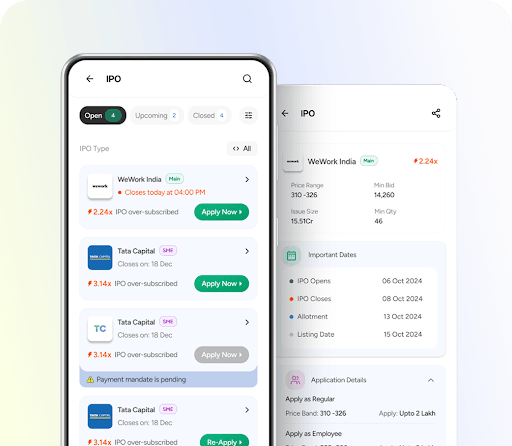
Browse IPO Opportunities
Explore current and upcoming Initial Public Offerings. Apply seamlessly and track your investments.
How to Invest in IPOs with Religare
IPO application is a fast, seamless and secure process via Religare Dynami App or Web Portal.

Open Your Account
Start your IPO journey with a free trading and demat account. Complete the digital KYC process.

Select Your IPO
Browse Live and Upcoming IPOs on our platform. Access Research insights for informed decisions.

Apply and Approve
Enter your bid and link your UPI ID. Approve the payment mandate from UPI app to block the funds.

Allotment - Listing
Track your application status. With SEBI’s new T+3 listing mandate, you can trade in shares immediately.

Why Choose Religare Broking
We combine three decades of trust with advanced technology for seamless execution. Our clients trade with absolute confidence, backed by professional research and market insights.

30+ Years
of Trust

All-in-One
Web and Mobile Platform

1300+
Touch Points

Client Centric
Approach
Understanding IPOs
Here is a comprehensive guide on IPOs so that you can navigate upcoming and live IPOs with confidence.
What is an Initial Public Offering (IPO)?
An Initial Public Offering (IPO) is the process through which a private company offers its shares to the public for the first time to raise equity capital from diverse investors. By doing so, the company transitions from being privately owned to becoming a publicly traded entity. Upcoming IPOs present an opportunity for strategic investors to potentially earn attractive returns on their investments through listing gains. While investing in IPOs can be rewarding, it requires careful evaluation and awareness. Not every IPO guarantees success, as potential gains come with inherent market risks. Therefore, before investing, it is essential to analyse the fundamentals and assess whether the opportunity aligns with your financial goals and risk tolerance.Step-by-Step: The IPO Launch Process in India
This is the standard regulatory process of launching an initial public offering in India:- Hire Investment Banks: The company appoints one or more investment banks (underwriters) to guide the IPO, assess finances, and plan capital raising.
- Prepare & File RHP: The company files a Draft Red Herring Prospectus (DRHP) with SEBI. Once cleared the Red Herring Prospectus (RHP) is filed with the ROC, detailing financials, risks, business plans, and fund usage.
- Apply to Stock Exchange: The company seeks in-principle approval for listing on the BSE and/or NSE.
- Roadshows: Company executives promote the upcoming IPO to institutional investors (QIBs) to generate interest and assess demand.
- Fix IPO Price: The price is set using either the fixed-price method or the book-building method.
- Open to Public: IPO opens for public subscription for 3-10 days.
- Allotment & Listing: Shares are allotted based on subscription levels, refunds are processed, and the stock begins trading on the exchanges.
Different Types of IPO
There are two main routes a company takes to go public:1. Fixed Price Offering
The company sets a specific price for its shares in its upcoming IPO. The price remains unchanged throughout the offering. Investors know the exact cost per share upfront, making this option simple and transparent.2. Book Building Offering
The company sets a price band with a floor price and a cap price. Investors place bids within this range. The final price is determined after the bidding process ends based on demand. This method is the industry standard as it reflects true market value.Advantages of Investing in Upcoming IPOs
Early Investment Opportunity: Investors get a chance to invest at an early stage and participate in the company’s future growth.- Portfolio Diversification: Adding IPOs helps spread risk by investing across emerging sectors and disruptive businesses.
- Listing Gains: IPOs, especially in fast-growing sectors like technology and healthcare, can deliver strong short term capital appreciation on the day of listing.
- Wealth Creation: Investing in well-managed companies at the right valuation can offer sustained compounding over time.
- Brand Visibility: A public listing mandates transparency and better corporate governance, which protects retail investors. It appreciates company’s recognition, which can boost demand and stock performance.
Investor’s Checklist: 5 Pillars of IPO Research before Applying
Some key points every investor needs to check before applying to any upcoming IPO:- The Business Model: Check how the company operates, earns revenue, and its competitive moat.
- Financial Health: Analyze at least three years of financial statements, profitability trends, and debt-to-equity ratios.
- Valuation Benchmarking: Compare valuation ratios like P/E and P/B with industry peers to judge pricing fairness.
- Purpose of Funds: Ensure IPO funds are for growth (expansion/R&D) rather than just debt repayment or promoter exit.
- Risk Factors: Read the RHP carefully to understand business strengths, market risks, and operational challenges of business.
Trade Anytime,
Anywhere
Experience India's seamless trading app with advanced features, intuitive design, and lightning-fast execution.

Unified Portfolio
All Assets, One App
Instant Market Alerts
Live Research, Zero Delay
Seamless Security
Biometric Login for Safe Trading
Actionable Ideas
Pre-built Options Strategies
Based on 27.4K reviews
1M+
Downloads